

Published
Key facts
- 5.36 million people lived in New Zealand at 30 June 2026 (provisional)1.
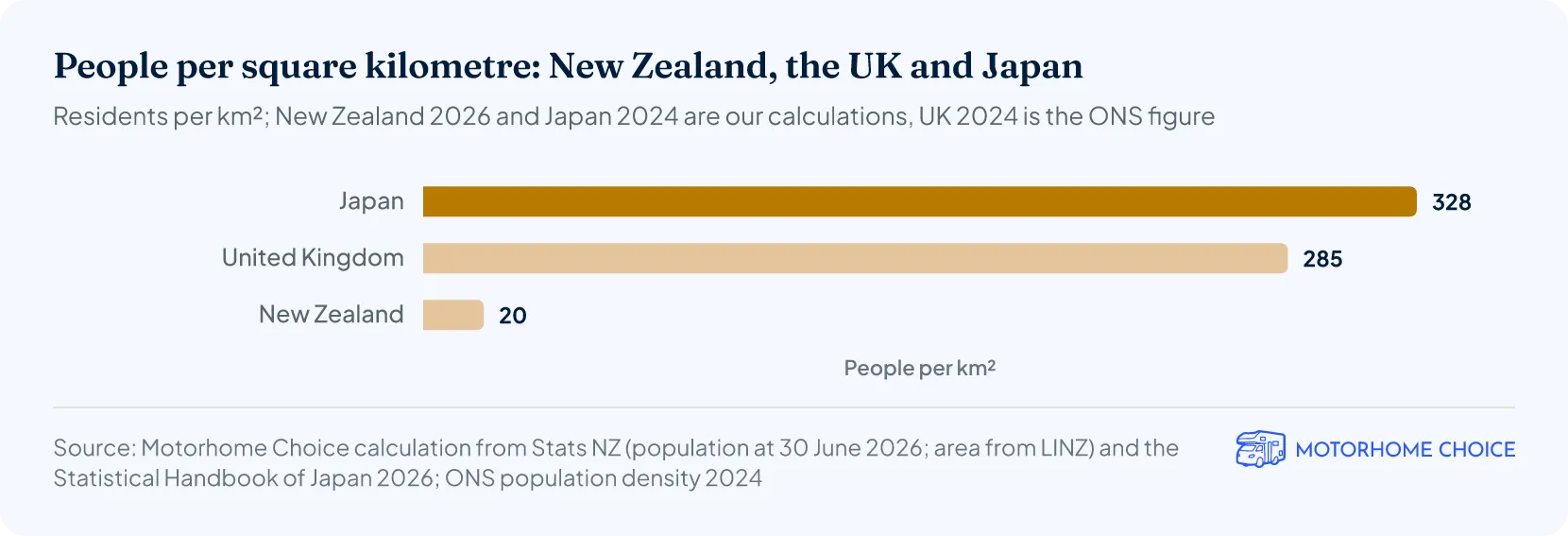
- About 268,000 km² (103,000 sq mi) is the country's total area, including lakes and rivers2.
- More than 600 smaller islands lie within about 50 km (31 miles) of the mainland coast (2009)4.
- 3,724 m (12,218 ft) is the height of Aoraki/Mount Cook, the highest mountain5.
- 425 km (264 miles) is the length of the Waikato River, the longest river6.
- 616 km² (238 sq mi) is the area of Lake Taupō (Taupo), the largest freshwater lake in Australasia (2025)7.
- 23.3 million sheep were farmed at 30 June 2025, about 4.4 for every person8.
- 32% of the country (8.7 million hectares) is public conservation land managed by the Department of Conservation (2022 figures)9.
How big is New Zealand?
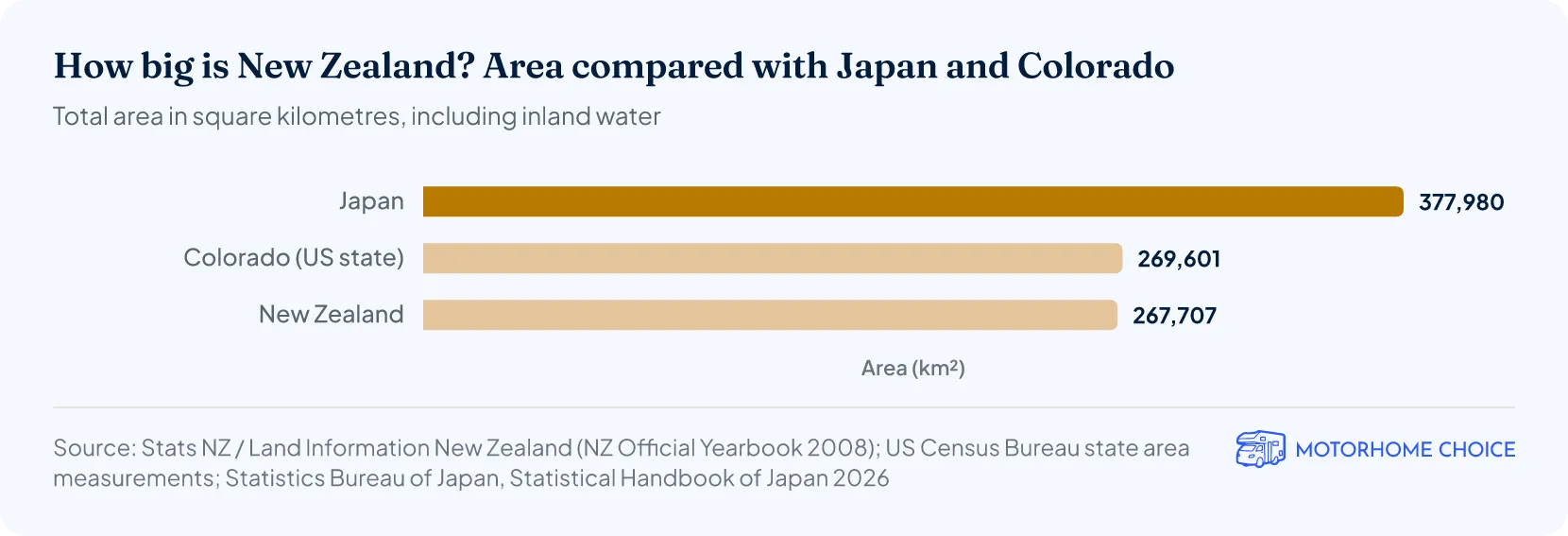
New Zealand covers 267,707 square kilometres (103,362 square miles), including its lakes and rivers, according to Land Information New Zealand figures in the New Zealand Official Yearbook 20082. That is almost exactly the size of the US state of Colorado (269,601 km²)10 and about 71% of the size of Japan (377,980 km²)11.
- The South Island is the larger of the two main islands at 150,416 km² (58,076 sq mi), 56% of the country; the North Island covers 114,154 km² (44,075 sq mi)2.
- New Zealand is more than 1,600 km (1,000 miles) long and 450 km (280 miles) across at its widest point2.
- To drive the length of both islands, compare campervan hire in New Zealand.
| Land area of New Zealand by island | |||
|---|---|---|---|
| Island | Area (km²) | Area (sq mi) | Share of total (%) |
| North Island | 114,1542 | 44,075 | 42.6 |
| South Island | 150,4162 | 58,076 | 56.2 |
| Stewart Island/Rakiura | 1,6812 | 649 | 0.6 |
| Chatham Islands | 9632 | 372 | 0.4 |
| Campbell Island/Motu Ihupuku | 1132 | 44 | 0.04 |
| Raoul Island | 342 | 13 | 0.01 |
| Other offshore islands (20 km² or larger) | 3462 | 134 | 0.1 |
| Total | 267,7072 | 103,362 | 100 |
Source · Stats NZ, New Zealand Official Yearbook 2008, Table 1.01 (data: Land Information New Zealand). Areas include lakes and rivers.
How many people live in New Zealand?
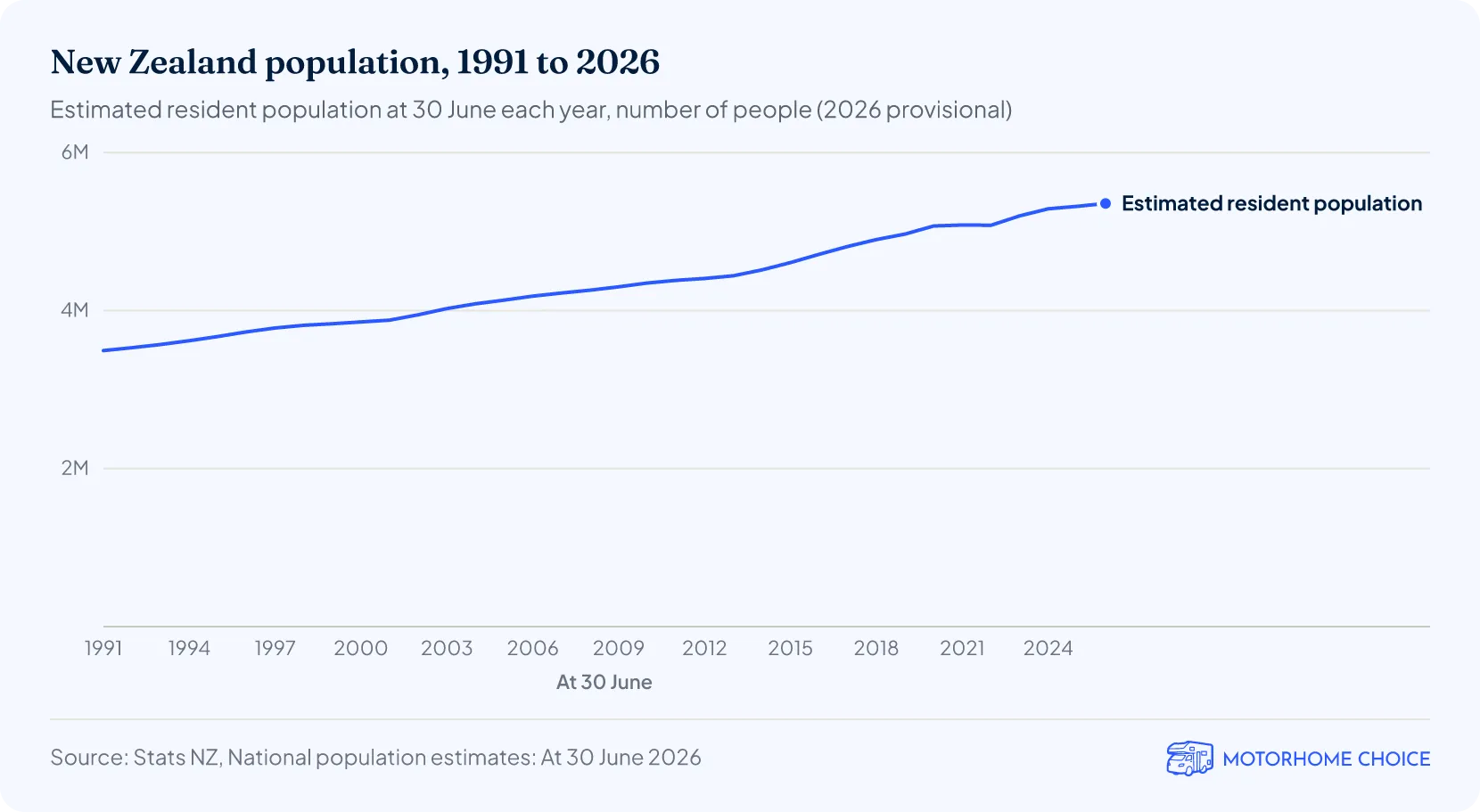
New Zealand's estimated resident population was 5,357,300 at 30 June 2026, according to provisional Stats NZ estimates1. The population grew by 36,400 (0.7%) in the year to June 2026.
- Births minus deaths added 18,700 people, the lowest natural increase since the early 1940s, during the Second World War; net migration added 17,6001.
- The population has grown 53% since 30 June 1991, when it was 3,495,1001.
- There were 2,699,500 females and 2,657,800 males at 30 June 20261.
- Overseas visitor arrivals were 3.71 million in the year to August 202612.
How crowded is New Zealand?
What are the largest cities in New Zealand?
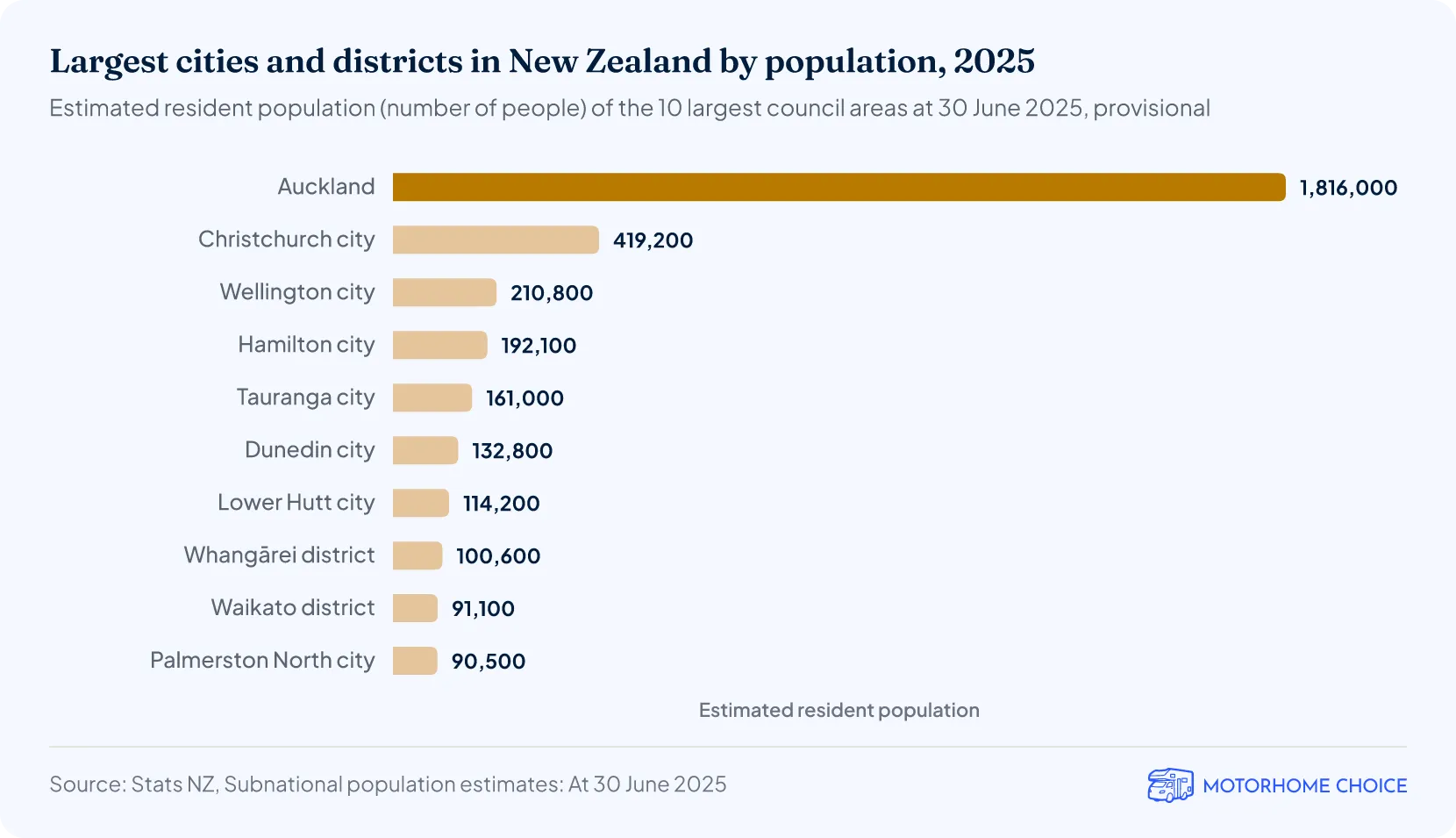
Auckland is New Zealand's largest city, with an estimated 1,816,000 residents at 30 June 2025, about one in three New Zealanders (34%)13. Christchurch (419,200) and the capital, Wellington (210,800), come next.
How many islands does New Zealand have?
New Zealand has two main islands and more than 600 smaller ones within about 50 km (31 miles) of the coast, according to Te Ara – the Encyclopedia of New Zealand4. Farther out are the outlying groups: the Kermadecs, the Chathams and the subantarctic islands.
How long is New Zealand's coastline?
New Zealand has more than 18,000 km (11,000 miles) of coastline, long for a country of its size, according to the New Zealand Official Yearbook 20082. The coast is deeply indented in places, which gives the country many natural harbours.
How high is New Zealand's highest mountain?
Aoraki/Mount Cook is New Zealand's highest mountain at 3,724 m (12,218 ft), according to the Department of Conservation5. Aoraki/Mount Cook National Park has 19 peaks over 3,000 m (9,843 ft), and glaciers cover 40% of the park.
- Aoraki is the mountain's Māori name: in legend, Aoraki was a young boy whose canoe was stranded on a reef, and the south wind turned him and his brothers to stone, creating the Southern Alps/Kā Tiritiri o te Moana5.
How long is the longest river in New Zealand?
The Waikato is New Zealand's longest river, at about 425 km (264 miles), according to Earth Sciences New Zealand (formerly NIWA)6. Its 14,260 km² (5,506 sq mi) catchment includes more than 17,000 km of tributary streams, Lake Taupō and eight hydro-electric dams.
- The river is Lake Taupō's only outlet; more than 30 rivers and streams flow into the lake7.
How big is Lake Taupō?
Lake Taupō (Taupo) covers 616 km² (238 sq mi), making it the largest freshwater lake in Australasia, according to Earth Sciences New Zealand7. Its maximum depth is about 184 m (604 ft), and it holds more than 60 cubic kilometres of water.
- The lake fills a caldera created by the Ōruanui eruption about 25,500 years ago7.
How deep is the deepest lake in New Zealand?
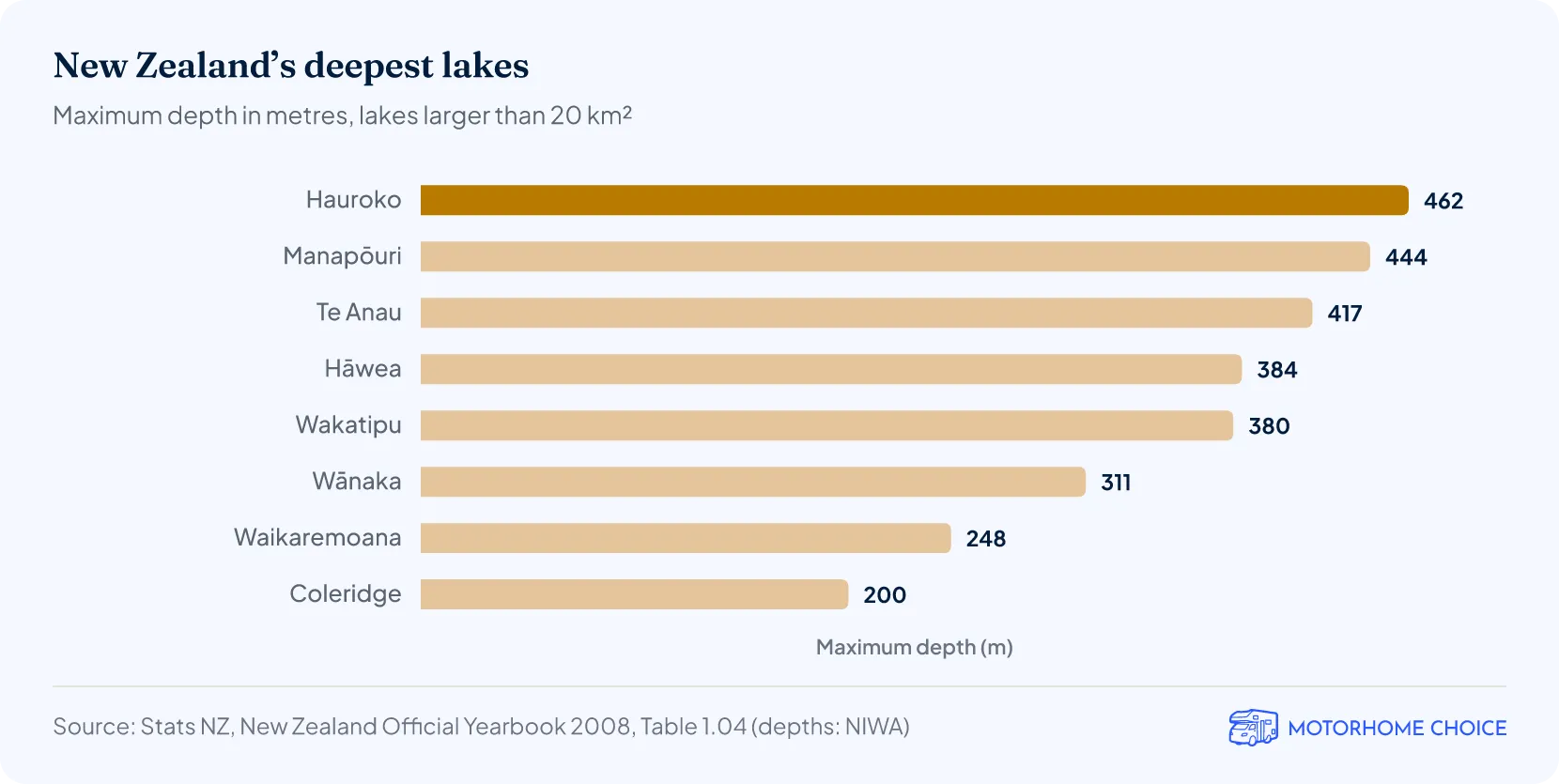
Lake Hauroko is New Zealand's deepest lake, at 462 m (1,516 ft), according to the New Zealand Official Yearbook 20082. Lake Manapōuri (444 m) and Lake Te Anau (417 m) are the next deepest.
- Six of the lakes larger than 20 km² are more than 300 m (984 ft) deep: Hauroko, Manapōuri, Te Anau, Hāwea, Wakatipu and Wānaka2.
How many sheep are there in New Zealand?
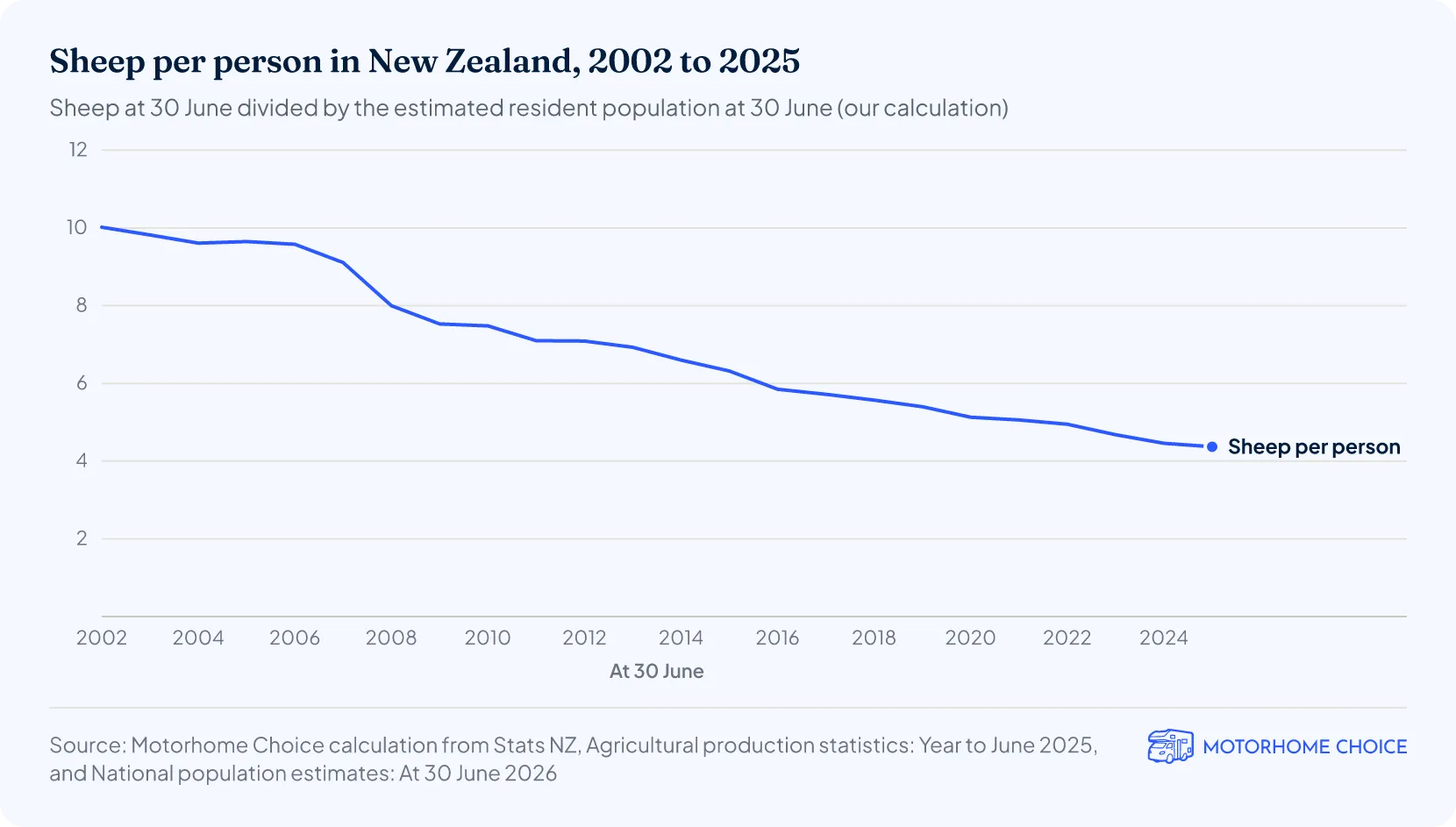
New Zealand had 23.3 million sheep at 30 June 2025, according to Stats NZ8, or about 4.4 for every person (our calculation). The flock fell 1% in the year to June 2025.
How much of New Zealand is conservation land?
About 8.7 million hectares (33,600 sq mi), or 32% of New Zealand, is public conservation land managed by the Department of Conservation, according to its November 2023 briefing to the incoming minister9. That includes nearly half of the South Island.
More New Zealand facts & statistics
Campervan hire in New Zealand
References
- National population estimates: At 30 June 2026stats.govt.nzPublished 2026-08-18 · Retrieved 2026-10-14
- Nearshore islands – A nation of islands (Te Ara – the Encyclopedia of New Zealand)teara.govt.nzPublished 2009-03-01 · Retrieved 2026-10-14
- How New Zealand's deep and large lakes reflect and are affected by climate changeniwa.co.nzRetrieved 2026-10-14
- Agricultural production statistics: Year to June 2025stats.govt.nzPublished 2026-04-16 · Retrieved 2026-10-14
- Briefing to the incoming Minister of Conservation, November 2023doc.govt.nzPublished 2023-11-01 · Retrieved 2026-10-14
- Subnational population estimates: At 30 June 2025stats.govt.nzPublished 2025-10-29 · Retrieved 2026-10-14