

Published
About 68,000 kiwi are left in New Zealand, according to Save the Kiwi, the national kiwi charity.1 Its estimates for the five species, most of them made in 2015, add up to just under 68,000.2 The Department of Conservation (DOC) uses a 2018 baseline of about 70,0003, and unmanaged kiwi populations are still falling by 2% a year.4
Key facts
- About 68,000 kiwi are left in New Zealand, down from an estimated 12 million in the past.1
- 2% a year is the rate at which unmanaged kiwi populations are falling, around 20 birds a week.4
- 5% of kiwi chicks survive to adulthood where predators are not controlled.3
- About half of kiwi chick deaths on the mainland are caused by stoats.4
- About 26,000 tokoeka make it the most numerous of the five kiwi species (2015 estimates)2, while the rowi, at about 450 birds in 2024, is the rarest.5
- 100,000 kiwi by 2030 is the national goal, which the plan aims to reach through growth of at least 2% a year across all five species.3
- At least 7,000 more North Island brown kiwi were counted in 2023 than in 2019 across 25 projects funded by Save the Kiwi.5
- December 2021 is when the North Island brown kiwi came off the threatened list; it is now classed as not threatened but conservation dependent.5
How many kiwi are left in New Zealand?
About 68,000 kiwi are left in the wild in New Zealand, Save the Kiwi estimates.1 There were once an estimated 12 million kiwi, but by 1998 there were fewer than 100,000, and by 2008 about 70,000.
- Save the Kiwi's estimates for the five species, most of them from 2015, add up to 67,550 birds2.6
- DOC's Kiwi Recovery Plan 2018–2028 started from about 70,000 kiwi in 20183, and DOC still gives that number.4
- The kiwi left today are roughly 1 in 180 of the estimated 12 million that once lived in New Zealand, or about 0.6% (our calculation).
| Kiwi numbers over time | ||
|---|---|---|
| When | Estimated kiwi | Estimate by |
| In the past | About 12 million1 | Save the Kiwi |
| 1998 | Fewer than 100,0001 | Save the Kiwi |
| 2008 | About 70,0001 | Save the Kiwi |
| 2015 | 67,5502 | Save the Kiwi |
| 2018 | About 70,0003 | DOC, Kiwi Recovery Plan |
| Today | Around 68,0001 | Save the Kiwi |
| 2030 goal | 100,0003 | DOC, Kiwi Recovery Plan |
Source · Save the Kiwi, Threats to kiwi and Kiwi species (checked October 2026); DOC, Kiwi Recovery Plan 2018–2028 summary (November 2018).
How many kiwi are there of each species?
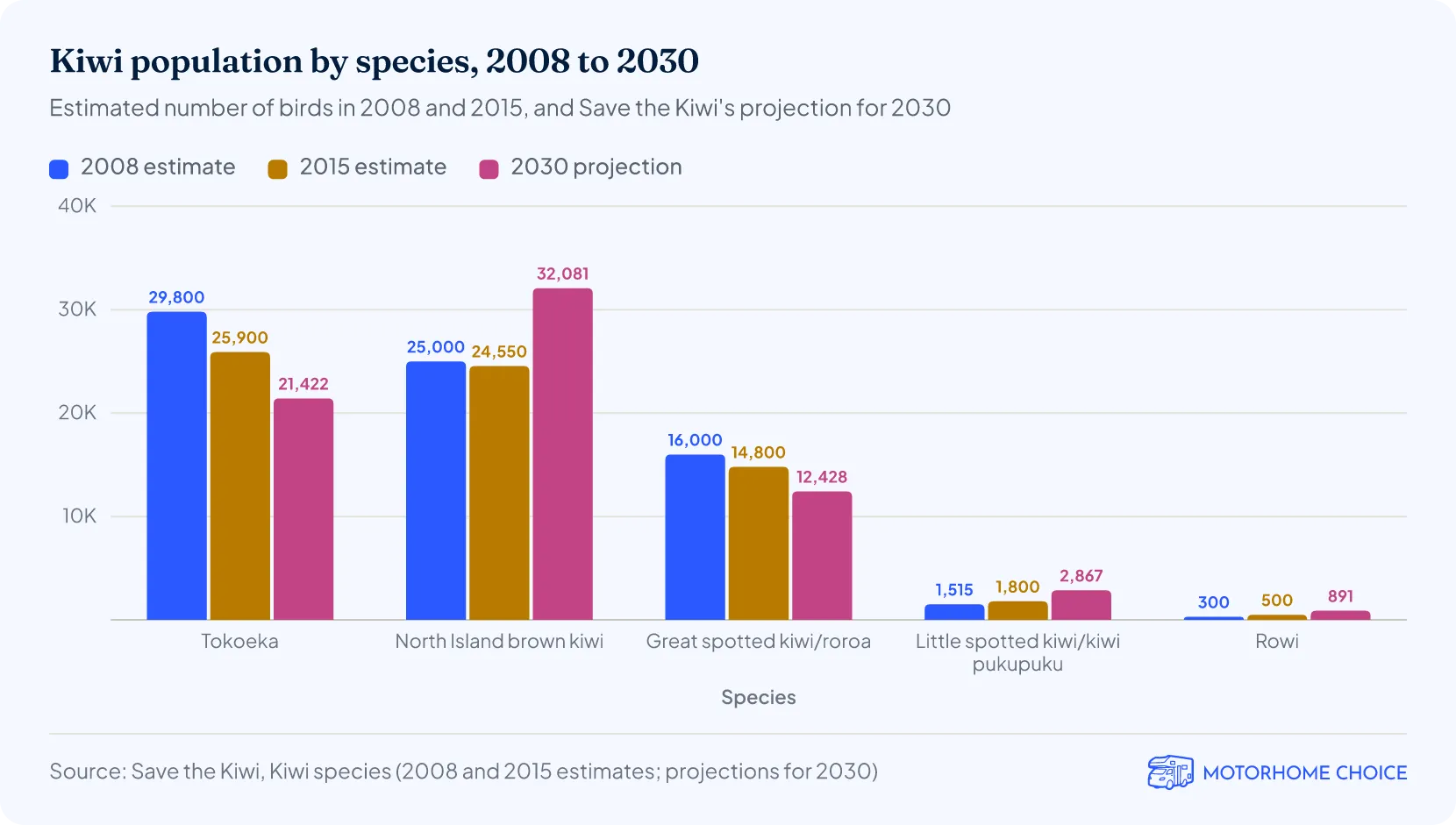
Tokoeka are the most numerous kiwi, with about 25,900 birds, followed by North Island brown kiwi at 24,550, great spotted kiwi/roroa at 14,800, little spotted kiwi at 1,800 and rowi at about 500, according to Save the Kiwi's 2015 estimates.2
- Between 2008 and 2015, rowi grew from 300 to 500 birds7 and little spotted kiwi from about 1,500 to 1,8008, while tokoeka fell from 29,800 to 25,900.9
- Save the Kiwi's projections for 2030 show North Island brown kiwi, little spotted kiwi and rowi growing, and great spotted kiwi and tokoeka still falling.2
| Kiwi species: population and threat status | |||||
|---|---|---|---|---|---|
| Species | Scientific name | Where they live | Estimate (2015) | Projected 2030 | Threat status |
| Tokoeka | Apteryx australis | Fiordland, Haast and Rakiura (Stewart Island) | 25,9002 | 21,4222 | Threatened (nationally vulnerable)2 |
| North Island brown kiwi | Apteryx mantelli | Northland, Coromandel, eastern and western North Island | 24,5502 | 32,0812 | Not threatened (conservation dependent)2 |
| Great spotted kiwi/roroa | Apteryx haastii | Northwest Nelson, Paparoa Range and near Arthur's Pass | 14,8002 | 12,4282 | Threatened (nationally vulnerable)2 |
| Little spotted kiwi/kiwi pukupuku | Apteryx owenii | Mostly Kapiti Island and fenced or island sanctuaries | 1,8002 | 2,8672 | Threatened (nationally increasing)2 |
| Rowi | Apteryx rowi | Ōkārito (Okarito), West Coast | 5002 | 8912 | Threatened (nationally endangered)2 |
| All five species | 67,550 | 69,689 | |||
Source · Save the Kiwi, Kiwi species and species pages (2015 estimates and 2030 projections, checked October 2026).
What is the rarest kiwi?
The rowi is the rarest kiwi species7, with about 450 birds in 2024.5 They live in the wild only at Ōkārito (Okarito), near Franz Josef on the West Coast of the South Island, and every rowi is under active management to protect it from predators.7
- Rowi numbers have recovered from a record low of about 150 to 200 birds in the mid-1990s, mainly thanks to Operation Nest Egg.7
- One group within a species is even rarer: the Haast tokoeka, estimated at just 400 birds.9
- In 2015, Save the Kiwi estimated 500 rowi.7
- Little spotted kiwi were thought to have died out in the South Island around 1980, but a small remnant population was found on the West Coast in 2025.8
Are kiwi birds endangered?
Yes. Save the Kiwi lists four of the five kiwi species as threatened under DOC's ratings: the rowi is nationally endangered, the great spotted kiwi and tokoeka are nationally vulnerable, and the little spotted kiwi is nationally increasing.2
- The North Island brown kiwi was taken off the threatened list in December 2021. It is now classed as not threatened, but conservation dependent, which means it would quickly become threatened again if intensive predator control stopped.5
- Ratings differ between sources: DOC says the status of kiwi ranges from Recovering to Nationally Critical4, and Save the Kiwi's February 2024 release calls rowi critically endangered.5
How fast are kiwi declining?
How many kiwi chicks survive?
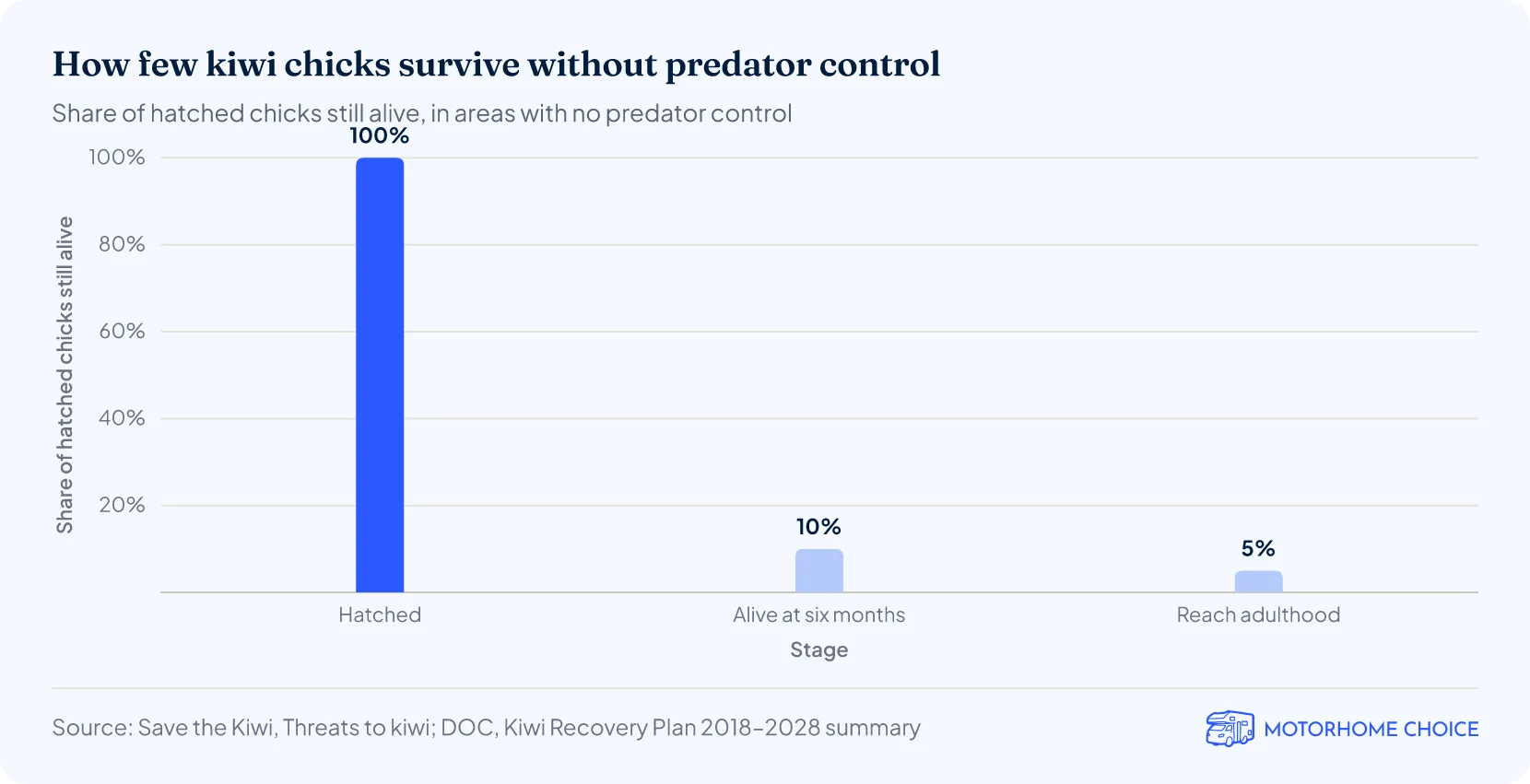
Only about 5% of kiwi chicks survive to adulthood in areas without predator control, according to DOC and Save the Kiwi.3 About 10% of chicks live past six months.1
- About half of all kiwi eggs fail to hatch, Save the Kiwi says.1
- Stoats cause about half of kiwi chick deaths on the mainland, DOC says.4 Chicks stay vulnerable to stoats until they weigh about 1 kg (2.2 lb), when they can usually defend themselves.
- Save the Kiwi puts the share of chicks killed by stoats or cats at 70%.1
What kills kiwi?
Predators are the biggest threat to kiwi: stoats kill the most chicks, and dogs kill the most adults.4 Cats also kill chicks, and ferrets often kill adult kiwi.
- Any dog, of any size, breed or training, can kill a kiwi4, and a single dog can set back years of growth in a local population.3
- Dogs have cut the average life expectancy of adult Northland brown kiwi to just 14 years, against a natural lifespan of 25 to 50 years.4
- Loss of forest habitat, cars, the small size of some populations, and possible new bird diseases are further threats.4
Will New Zealand reach 100,000 kiwi by 2030?
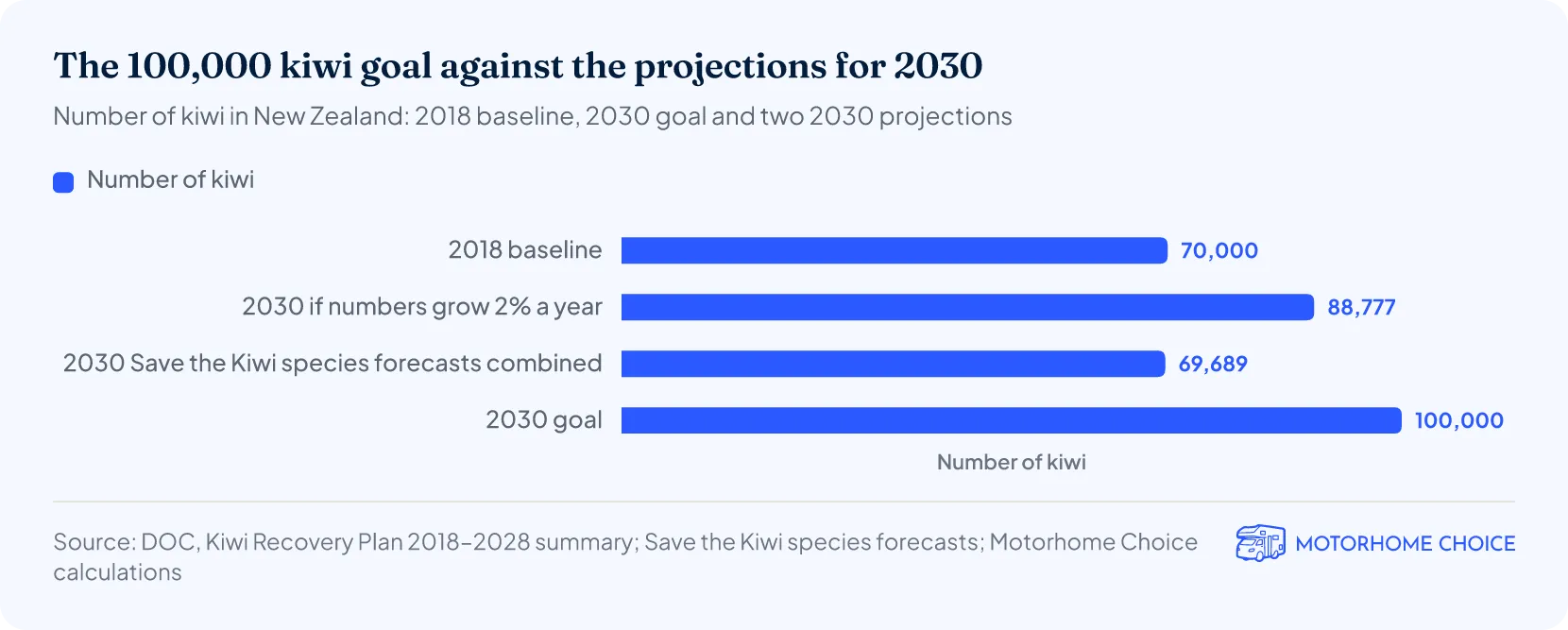
New Zealand is not on track to reach its goal of 100,000 kiwi by 2030 on current projections. Save the Kiwi's 2030 projections for the five species add up to about 69,700 kiwi (our calculation)2, about 30,300 short of the goal set in DOC's Kiwi Recovery Plan 2018–2028.3
- Even growth of 2% a year, the plan's minimum3, would take 70,000 kiwi in 2018 to about 88,800 by 2030. Reaching 100,000 needs growth of about 3% a year (our calculations).
- There are signs of faster growth in managed areas: across 25 projects funded by Save the Kiwi, North Island brown kiwi numbers rose by at least 7,000 between 2019 and 2023.5 Growth of 2% a year would have needed just 2,600 more birds.
- The 2030 projections were made from the 2015 estimates6, before the 2018 plan and the extra predator control it funded, so they may understate recent gains.
How long do kiwi live?
Kiwi can live for between 25 and 50 years, DOC says.4 Chicks hatch fully feathered, leave the nest to feed at about five days old and are never fed by their parents. Young kiwi take three to five years to reach adult size.
What is being done to save kiwi?
More than 90 community and iwi-led groups protect kiwi over about 230,000 ha (about 890 sq mi), almost as much as the public conservation land DOC protects for kiwi.4 The Kiwi Recovery Plan 2018–2028 aims to grow kiwi numbers by at least 2% a year through predator control, dog management, protecting genetic diversity and supporting iwi and community projects.3
- The government's Save Our Iconic Kiwi funding package, set up in 2018, funds projects that aim to grow each of the five species by 2% a year.5
- If you are touring New Zealand in a hired campervan or motorhome, take care on roads through kiwi country: DOC lists being hit by vehicles among the threats to kiwi.4
More New Zealand facts & statistics
Campervan hire in New Zealand
References
- Kiwi Recovery Plan 2018–2028 – Summary (Department of Conservation, November 2018)doc.govt.nzPublished 2018-11-01 · Retrieved 2026-10-14
- Kiwi population grows by 7,000 (Save the Kiwi, 28 February 2024)savethekiwi.nzPublished 2024-02-28 · Retrieved 2026-10-14