


Published
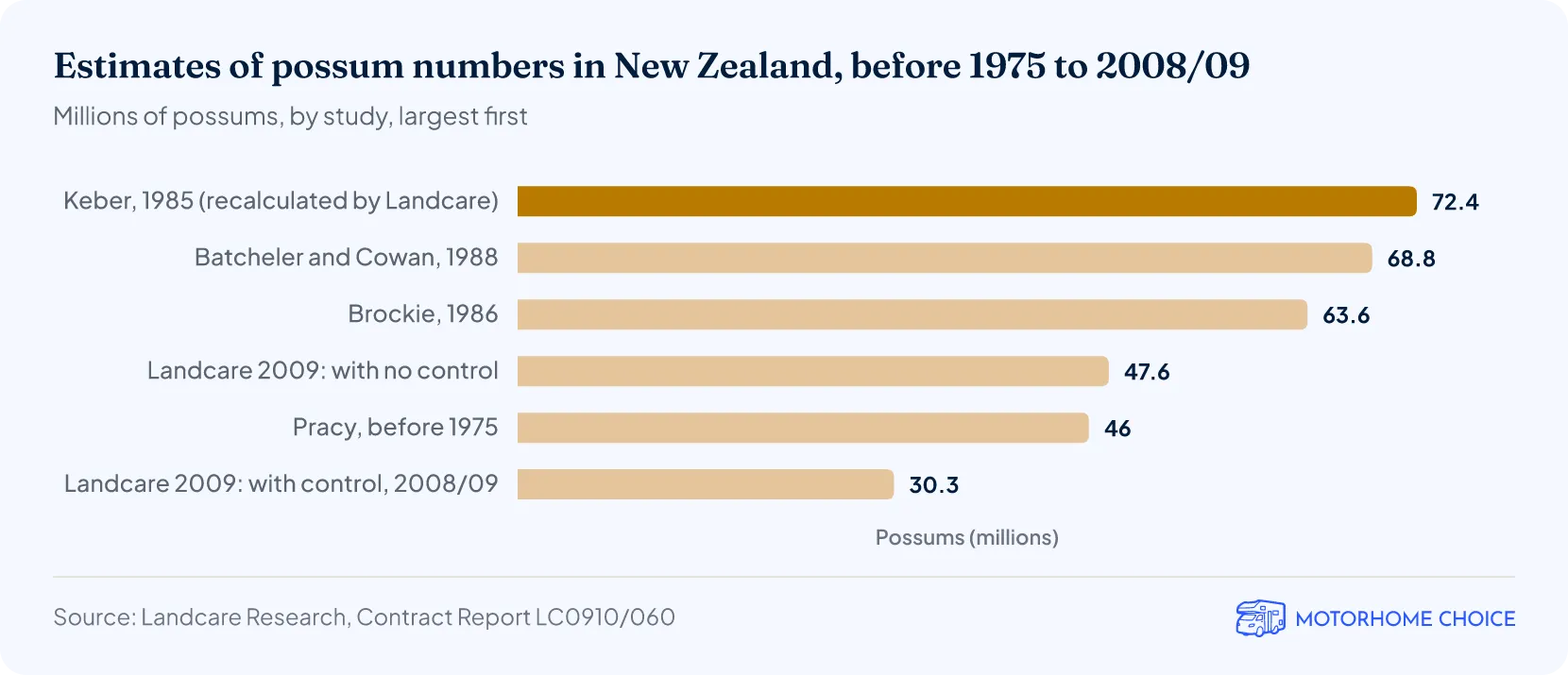
New Zealand had about 30 million possums in 2008/09, according to the latest national estimate, published by Landcare Research (now Manaaki Whenua) in December 20091. Without pest control, the same study put the number at about 48 million, well below the 70 million widely quoted since the 1980s.
Key facts
- About 30 million possums lived in New Zealand in 2008/09, the latest national estimate1.
- 1837 was the year brushtail possums were first released from Australia to start a fur trade; they became established after a second release in 18582.
- 25 million native birds a year are killed by rats, stoats, possums and other introduced predators, by the Department of Conservation's estimate (2025/26)3.
- NZ$3.3 billion a year was the Government's estimate of the total economic cost of introduced pests (July 2016)4.
- 2050 is the target year for ridding all of New Zealand of rats, stoats and possums, set in July 20164; on 21 November 2025 the Government announced that feral cats would be added to the list5.
- 2 of 7 interim Predator Free goals for 2025 were achieved, according to the Department of Conservation's 2026 review6.
- Over 2.5 million hectares (6.2 million acres) of land were under sustained predator suppression at June 20256.
- 1.05 million hectares (2.6 million acres) were treated with aerial 1080 poison in 2024, the most since EPA reporting began7.
How many possums are there in New Zealand?
About 30 million possums lived in New Zealand in 2008/09, according to the most recent national estimate, made by Landcare Research (now Manaaki Whenua) in 20091. Without any pest control, the study estimated 47.6 million, so control was holding numbers about 36% lower.
- Possum control in 2008/09 covered about 13.3 million hectares (33 million acres), around half of New Zealand's vegetated land1.
- Most possums live in native forest: without control, about 28.5 million of the 47.6 million (60%) would be in native forest other than beech1.
- The 2008/09 estimate is about 5.7 possums for every person living in New Zealand today (our calculation)8.
- Across the 26.8 million hectares the study mapped, it works out at about 113 possums per square kilometre (about 290 per square mile), by our calculation1.
- The authors warn that, until better estimates of how many possums each type of land can carry are available, the total "will always be speculative"1.
Are there really 70 million possums in New Zealand?
No: the 70 million figure comes from estimates made in the 1980s, and Landcare Research's 2009 review put the number without control at 48 million1. The review calls 70 million "the widely quoted figure for the past two decades".
- The 1980s estimates ranged from 63.6 million (Brockie, 1986) to 72.4 million (Keber, 1985, as recalculated by Landcare); Batcheler and Cowan (1988) estimated 68.8 million1.
- The review gives two reasons for the gap: earlier estimates used a much larger area of scrub (9.3 million hectares against 2.6 million) and gave it a high density of 4.6 possums per hectare1.
- Swapping the inputs between two of the 1980s studies produced anything from 41 million to 94.5 million possums1.
Where are New Zealand's possums?
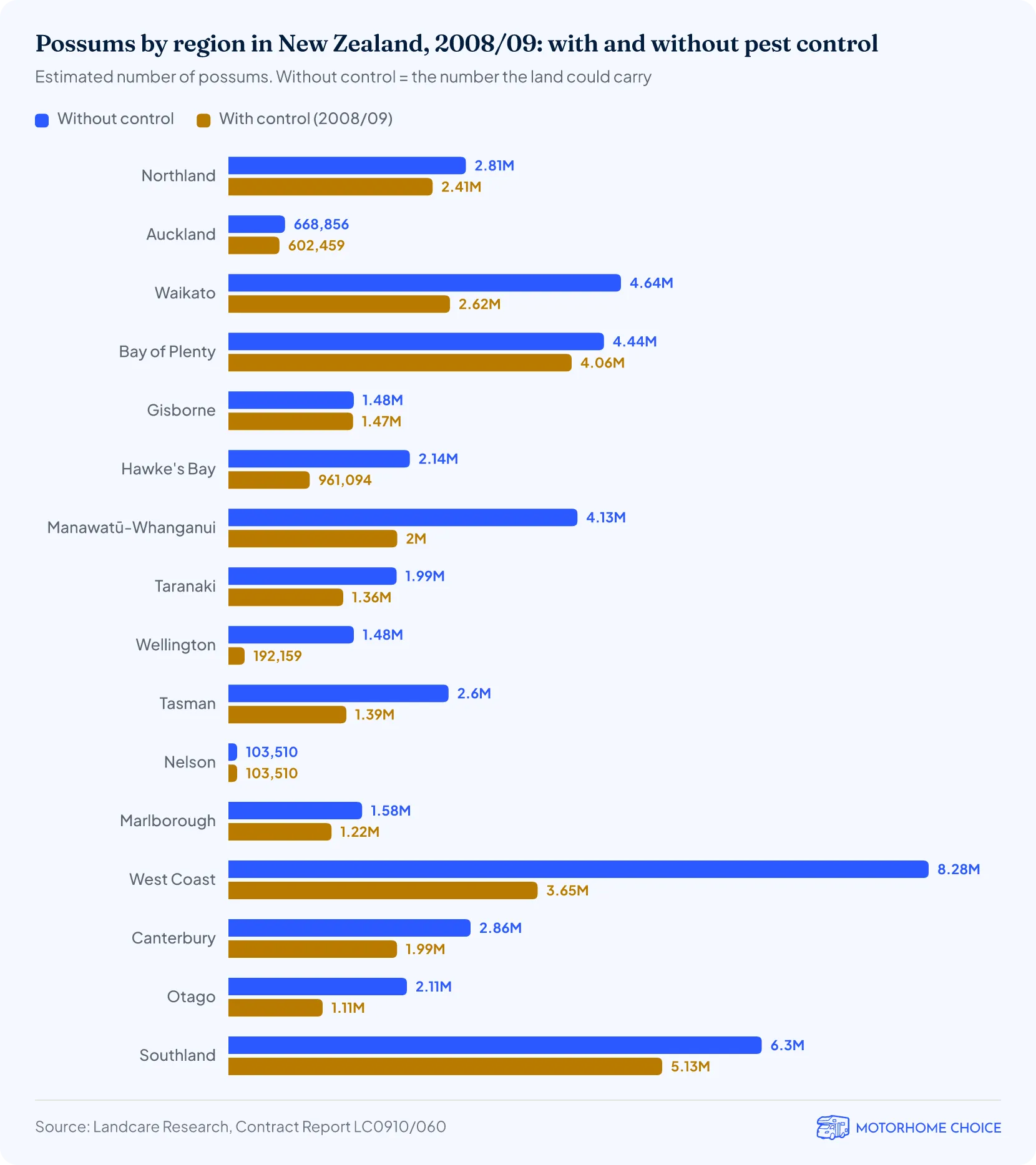
Southland had the most possums in 2008/09, about 5.1 million, followed by Bay of Plenty (4.1 million) and the West Coast (3.7 million), according to Landcare Research1. The West Coast would have the most without control: about 8.3 million.
What damage do possums do?
Possums mainly eat leaves, but they are "opportunistic omnivores" that also eat native birds and their eggs, land snails and insects such as wētā (weta), according to the Department of Conservation (DOC)2. They compete with native birds and reptiles for buds, flowers, fruit and nectar, and favour trees such as rātā and kāmahi.
- They nest in tree holes that birds such as kākāriki (parakeets) and saddlebacks would otherwise use2.
- Nest cameras in South Westland have recorded stoats and possums eating kea2.
- Possums strip the forest canopy and can cause forest collapse by eating new shoots, flowers and fruit3.
- They carry and spread bovine tuberculosis (TB)3. OSPRI, which runs TB control, reported 15 infected herds at 16 July 2025, down from 695 in 20007.
- DOC puts the economic loss in primary production from possum damage and control "in the tens of millions"2.
Are possums protected in Australia?
Yes. In Victoria, for example, possums "are protected under the Wildlife Act 1975", and it is illegal to harm or harass them, although common brushtail possums living in buildings, municipal parks and gardens may be controlled9. In New Zealand the same species, the common brushtail possum (Trichosurus vulpecula), is a pest that the Predator Free 2050 goal aims to eradicate2.
How many native birds do predators kill each year?
Rats, stoats, possums and other introduced predators kill an estimated 25 million native birds a year, according to DOC (2025/26)3. That is about 68,000 birds a day. The same figure was given when the Predator Free 2050 goal was announced in July 20164.
- New Zealand's native plants and animals evolved for more than 80 million years without mammal predators3.
- Without predator control, DOC warns, many more native animal populations will become extinct in less than two human generations3.
- DOC puts kiwi numbers at about 70,000 and says unmanaged populations are losing 2% a year, around 20 birds a week10.
How many stoats are there in New Zealand?
No national count of stoats has been published. DOC says they live "anywhere from beaches to remote high country"; stoats, weasels and ferrets were introduced as early as 1879 to control rabbits11.
- Stoats cause about half of kiwi chick deaths on the mainland, and without management only 10% of kiwi chicks survive to six months10.
- A stoat needs the food equivalent of 12.5 pīwakawaka (fantail) chicks a day, and a female can have up to 12 kits at a time3.
- Stoats can swim 1.5 km (0.9 miles) to reach islands, and young stoats have travelled more than 70 km (43 miles) in two weeks11.
- DOC says stoats are implicated in the extinction of the South Island subspecies of bush wren, laughing owl and New Zealand thrush11.
How many rats are there in New Zealand?
There is no national count of rats either. Three introduced species live in New Zealand: the ship rat, the most common; the Norway rat; and the kiore (Pacific rat). DOC links the kiore to the migration of Polynesians across the Pacific; on the mainland it now lives only in the south of the South Island12.
- A female ship rat can produce up to 10 young every 8 weeks3.
- When beech trees seed heavily (a "mast"), about 50 million seeds can fall on a single hectare, fuelling a rat plague and then a surge in stoats3.
- The 2000 beech mast led to a rat plague that wiped out 85% of the southern population of wild kākāriki karaka (orange-fronted parakeet)3.
| The Predator Free 2050 target predators | ||
|---|---|---|
| Predator | How it reached New Zealand | Main harm, according to DOC and the Government |
| Brushtail possum | Released from Australia in 1837 to start a fur trade; established after a second release in 18582 | Eats native birds, eggs, snails and the leaves, flowers and fruit of native trees; spreads bovine TB |
| Ship rat and Norway rat | Transported on whaling ships and with early European settlers3 | Eat native birds, chicks, eggs, insects and seeds; climb to reach nests |
| Stoat (with ferrets and weasels) | Introduced as early as 1879 to control rabbits11 | The biggest threat to kiwi chicks; kills hole-nesting birds |
| Feral cat (addition announced 21 November 2025)5 | — | Preys on native birds, bats, lizards and insects; spreads toxoplasmosis5 |
Source · Department of Conservation: Predator Response 2025/26 and its possum, stoat and kiwi pages; Minister of Conservation, Feral cats to be added to Predator Free 2050 (21 November 2025).
What is Predator Free 2050?
Predator Free 2050 is the New Zealand Government's goal, adopted in July 2016, that "by 2050 every single part of New Zealand will be completely free of rats, stoats and possums"4. On 21 November 2025 the Government announced that feral cats would be added to the target list, with detail due in the revised strategy in March 20265.
- The Government started with NZ$28 million for a new company, Predator Free New Zealand Limited, on top of the NZ$60 million to NZ$80 million it already spent on pest control each year4.
- DOC now partners on 20 large predator-free projects covering 1,107,800 hectares (2.7 million acres), which it says is about 18 times the size of Lake Taupō (Taupo)13.
- New Zealand has eradicated predators from two-thirds of its offshore islands, and achieved the world's first island eradication in 196013.
- More than 9,000 projects upload their trapping results to Trap.nz13.
- Close to 3,400 submissions were made on the Predator Free Strategy, and over 90% backed better feral cat management; pet cats are not part of the target5.
Fenced sanctuaries and pest-free islands are where the results are easiest to see, and DOC encourages people to visit them13. If you are touring with campervan hire in New Zealand, DOC's interactive map of predator control projects can help you find one near your route.
Is New Zealand on track to be predator free by 2050?
Two of the seven interim goals set for 2025 were achieved, according to DOC's 2026 review: the area of mainland under predator suppression grew by 1 million hectares (achieved in 2021), and tools to eradicate predators on farmland were developed6. By June 2025, more than 2.5 million hectares (6.2 million acres) were under sustained predator suppression.
The other five goals were judged "achievable, but not by 2025"6. Clearing predators from all 160 offshore islands is taking longer than expected. A new strategy, Innovate for a predator-free New Zealand (2026–2030), sets the next goals.
| Predator Free 2025 interim goals and progress | ||
|---|---|---|
| Goal for 2025 | Progress by 2025 | Result |
| Increase the mainland area where predators are suppressed by 1 million hectares (from 2016) | Over 2.5 million hectares under sustained predator suppression at June 20256 | Achieved (2021) |
| Show predator eradication on at least 20,000 hectares of mainland, defended without fences | South Westland: initial assessments indicate elimination on at least 20,000 hectares; independent verification under way6 | Not by 2025 |
| Eradicate all mammalian predators from uninhabited offshore islands | Taking longer than expected; effort focused on Maukahuka Pest Free Auckland Island | Not by 2025 |
| Develop a science breakthrough able to eradicate at least one small mammal predator from the mainland | Research advancing on future tools such as genetics and fertility control | Not by 2025 |
| At least five eradication projects led by whānau, hapū and iwi | Four hapū- and iwi-led projects under way6 | Not by 2025 |
| Eradicate possums or mustelids from at least one city | Possums, rats and mustelids eliminated from Te Motu Kairangi / Miramar Peninsula, Wellington6 | Not by 2025 |
| Effective tools and knowledge for predator eradication on farmland | Predator elimination on farmland achieved at varying scales | Achieved |
Source · Department of Conservation, Review of progress against the Predator Free 2025 goals (2026).
How much 1080 poison is used in New Zealand?
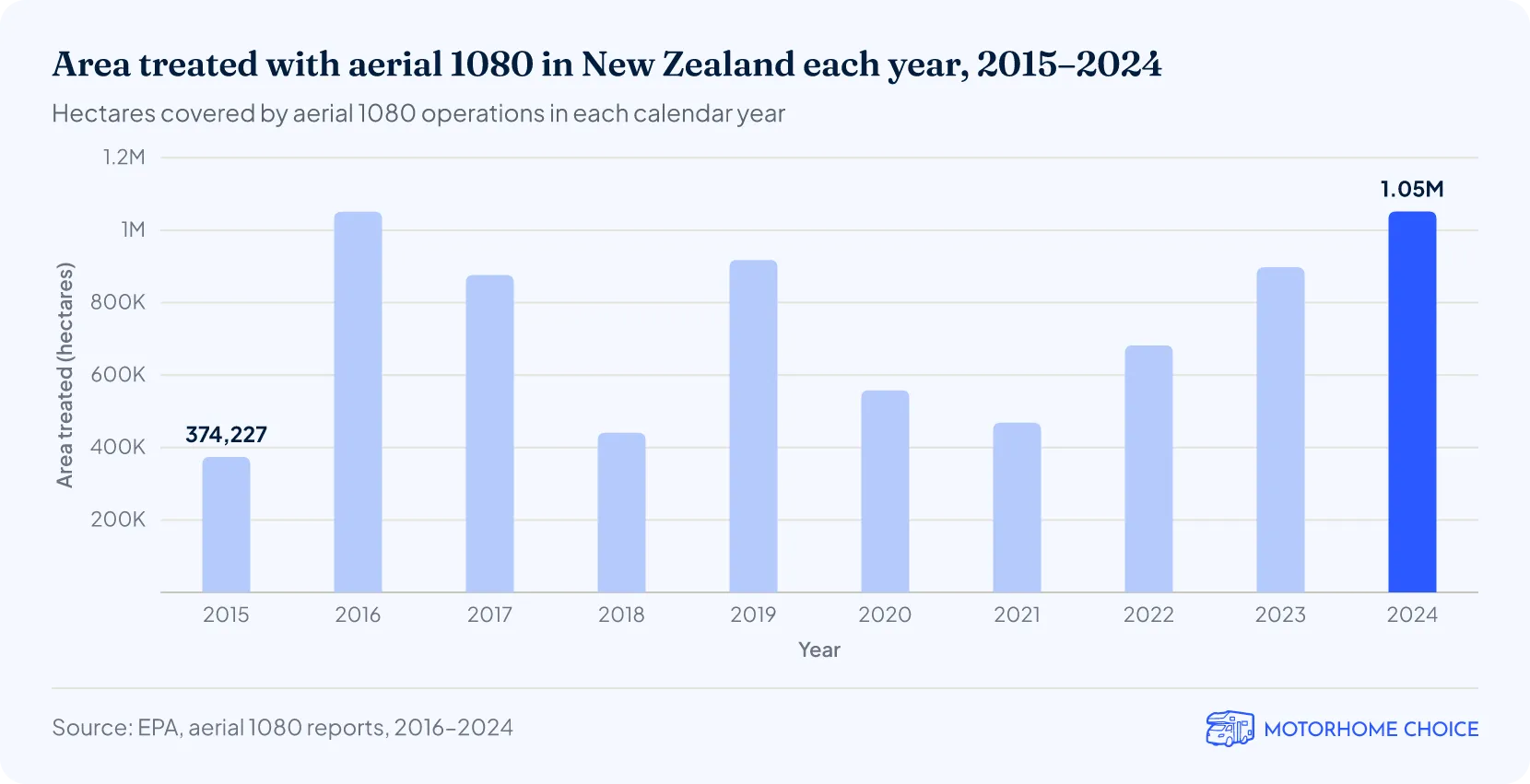
Aerial 1080 operations covered 1,052,056 hectares (2.6 million acres) in 2024, the largest area and the most operations (65) since the Environmental Protection Authority (EPA) began reporting7. The EPA links the rise to heavy beech seeding in 2023. The 2024 area was 2.8 times the 374,227 hectares treated in 201514.
- 1080 (sodium fluoroacetate) is dropped from helicopters as bait pellets over large, remote and rugged areas where traps cannot be used; DOC says four to six pellets typically land in an area the size of a tennis court3.
- On average, DOC says, an operation removes 98–100% of rodents and 90–100% of possums and stoats, but numbers rebound, so operations have to be repeated3.
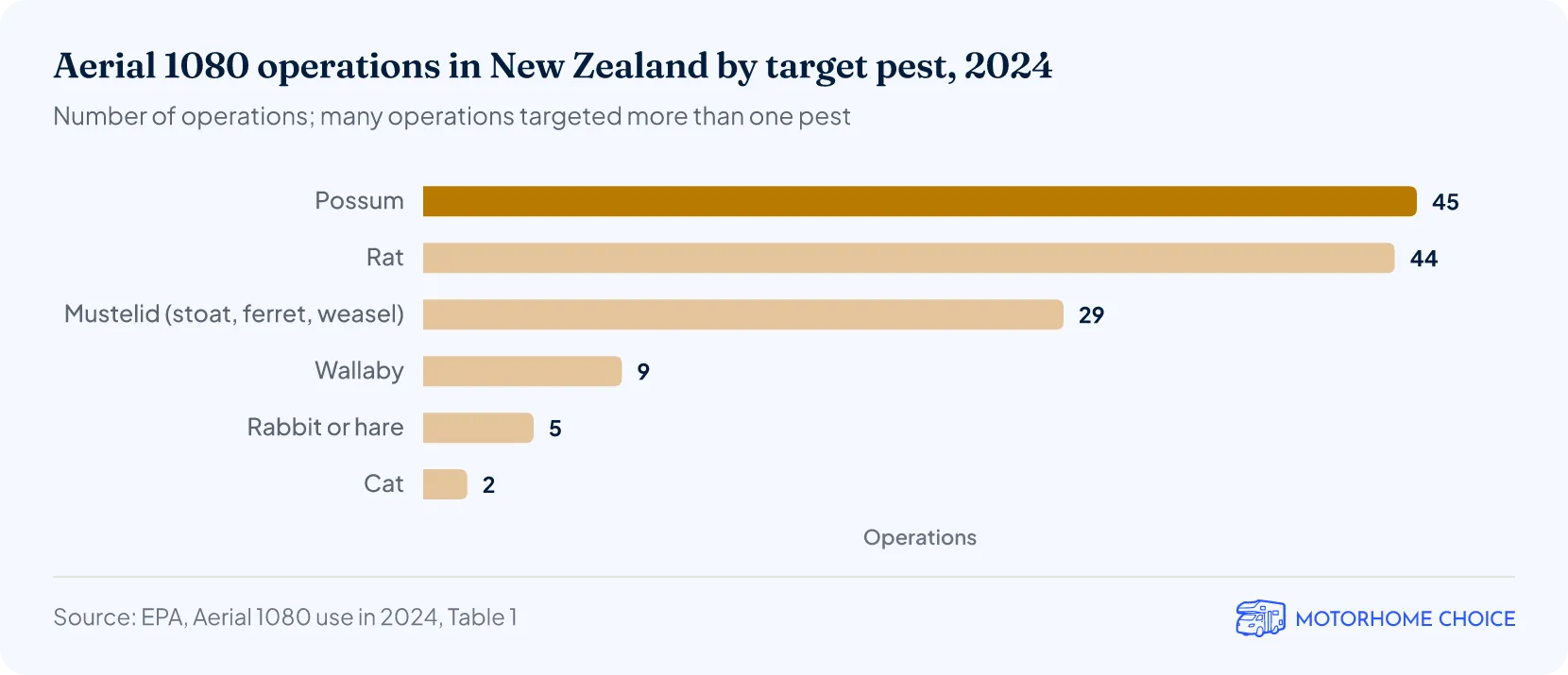
- Of the 2024 operations, 45 targeted possums, 44 rats and 29 mustelids; many targeted more than one pest7.
- The EPA received 29 incident notifications from 17 of the 65 operations in 2024, including nine reports of non-target animal deaths and nine cases of bait landing where it was not supposed to7.
- The EPA says the use of 1080 "can be controversial". In 2007 its predecessor, ERMA, reassessed 1080 and decided that, with tighter controls, its benefits outweighed the risks; since then operators have had to report on every aerial operation7.
More New Zealand facts & statistics
Campervan hire in New Zealand
References
- How many possums are now in New Zealand following control and how many would there be without it? (Landcare Research Contract Report LC0910/060)datastore.landcareresearch.co.nzPublished 2009-12-01 · Retrieved 2026-10-14
- Predator Response 2025/26: Protecting native species (Department of Conservation)doc.govt.nzPublished 2025-07-01 · Retrieved 2026-10-14
- New Zealand to be Predator Free by 2050 (Prime Minister John Key, beehive.govt.nz)beehive.govt.nzPublished 2016-07-26 · Retrieved 2026-10-14
- Feral cats to be added to Predator Free 2050 (Minister of Conservation media release)doc.govt.nzPublished 2025-11-21 · Retrieved 2026-10-14
- Review of progress against the Predator Free 2025 goals (Department of Conservation)doc.govt.nzPublished 2026-03-01 · Retrieved 2026-10-14
- Aerial 1080 use in Aotearoa New Zealand in 2024: annual report on the aerial use of 1080 (Environmental Protection Authority)epa.govt.nzPublished 2025-12-01 · Retrieved 2026-10-14
- Population of New Zealand: estimated resident population (Stats NZ)stats.govt.nzPublished 2026-08-18 · Retrieved 2026-10-14
- Possums: managing wildlife (Victorian Government, wildlife.vic.gov.au)wildlife.vic.gov.auRetrieved 2026-10-14
- Annual report on the aerial use of 1080, 2016 (Environmental Protection Authority)epa.govt.nzRetrieved 2026-10-14