

Published
Key facts
- 13 national parks as at October 2026: nine on the South Island, three on the North Island and one on Stewart Island/Rakiura1.
- Nearly 3 million hectares (about 29,700 km²; 11,500 sq mi) of national park in total, 34% of all public conservation land (October 2026)1.
- 8.6 million hectares of land is managed by DOC, nearly a third of New Zealand (2024/25)3.
- Fiordland is the largest park at 1.28 million hectares (about 12,800 km²; 4,900 sq mi), 43% of all national-park land (October 2026)1.
- Abel Tasman is the smallest at about 23,500 hectares (235 km²; 91 sq mi) (October 2026)1.
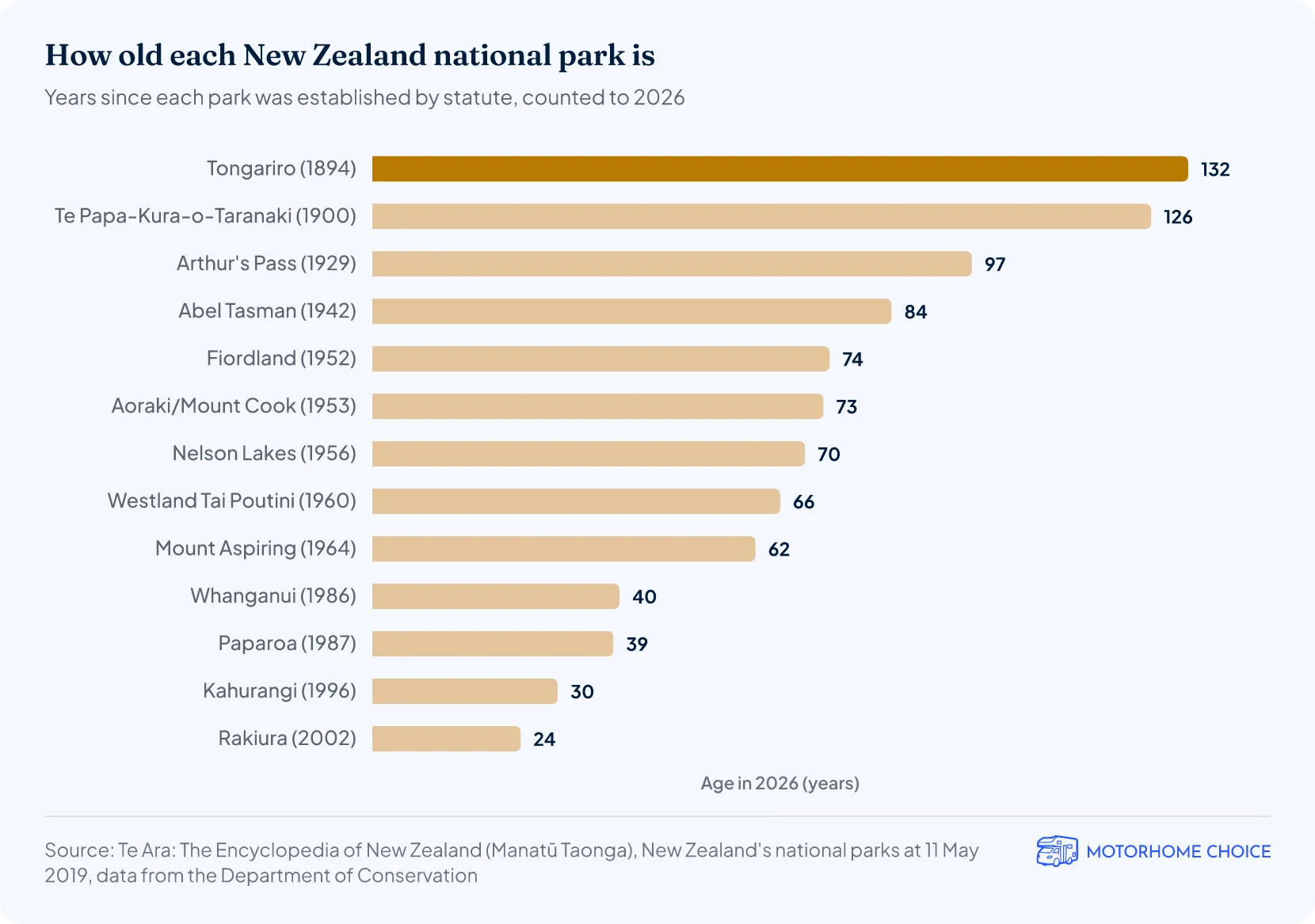
- Tongariro is the oldest, established in 1894: "a first for New Zealand, and fourth in the world", in DOC's words2.
- Rakiura is the newest, established in 20024.
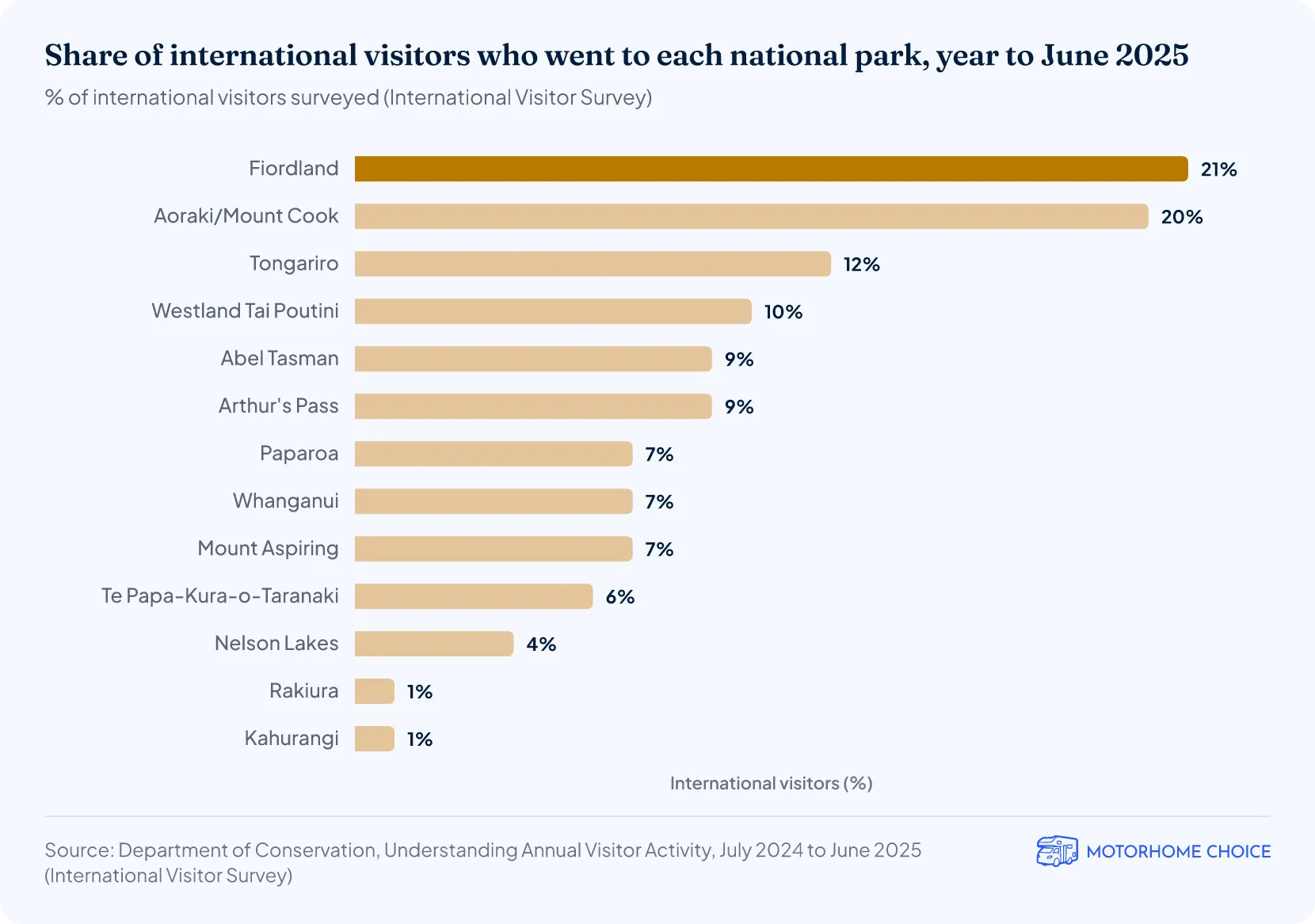
- 21% of international visitors went to Fiordland in the year to June 2025, more than to any other park5.
All 13 national parks by size and age
| National park | Island | Established | Area (ha) | Area (km²) | Area (sq mi) | Share of park land |
|---|---|---|---|---|---|---|
| Fiordland | South Island | 1952 | 1,278,970 | 12,790 | 4,938 | 43% |
| Kahurangi | South Island | 1996 | 516,846 | 5,168 | 1,996 | 17.4% |
| Mount Aspiring | South Island | 1964 | 359,443 | 3,594 | 1,388 | 12.1% |
| Rakiura | Stewart Island/Rakiura | 2002 | 140,351 | 1,404 | 542 | 4.7% |
| Westland Tai Poutini | South Island | 1960 | 131,709 | 1,317 | 509 | 4.4% |
| Arthur's Pass | South Island | 1929 | 118,522 | 1,185 | 458 | 4% |
| Nelson Lakes | South Island | 1956 | 101,196 | 1,012 | 391 | 3.4% |
| Tongariro | North Island | 1894 | 78,846 | 788 | 304 | 2.7% |
| Whanganui | North Island | 1986 | 74,387 | 744 | 287 | 2.5% |
| Aoraki/Mount Cook | South Island | 1953 | 72,148 | 721 | 279 | 2.4% |
| Paparoa | South Island | 1987 | 43,307 | 433 | 167 | 1.5% |
| Te Papa-Kura-o-Taranaki (formerly Egmont) | North Island | 1900 | 34,078 | 341 | 132 | 1.1% |
| Abel Tasman | South Island | 1942 | 23,506 | 235 | 91 | 0.8% |
How many national parks are there in New Zealand?
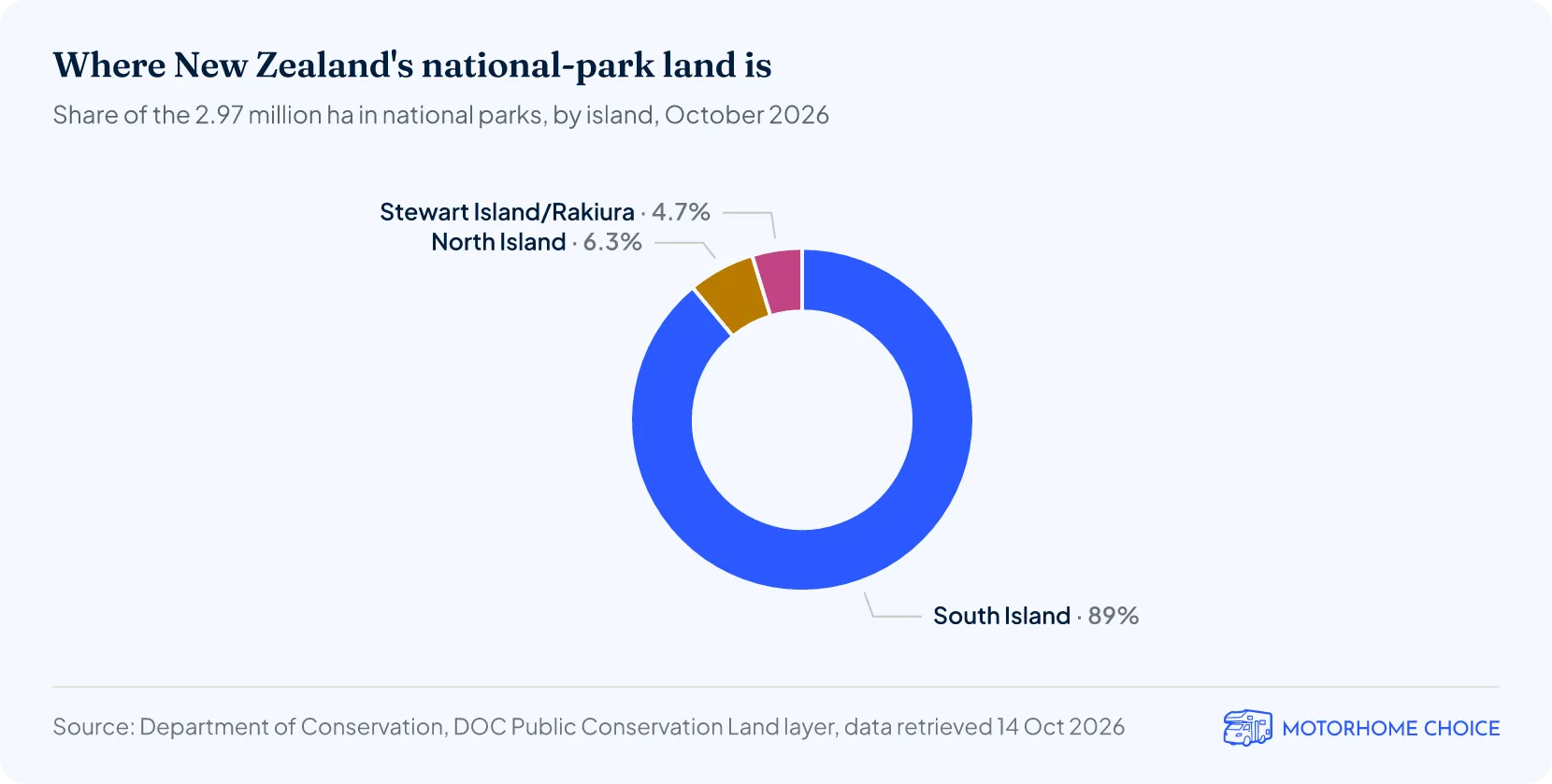
There are 13 national parks in New Zealand as at October 2026, according to DOC's Public Conservation Land layer1. Nine are on the South Island, three are on the North Island (Tongariro, Whanganui and Te Papa-Kura-o-Taranaki) and one, Rakiura, is on Stewart Island/Rakiura.
By area, the South Island holds 89% of all national-park land (2.65 million hectares)1, the North Island 6% (187,311 hectares) and Stewart Island/Rakiura 5% (140,351 hectares).
Te Urewera stopped being a national park under the Te Urewera Act 20146, which gave it a legal identity of its own. Egmont National Park was renamed Te Papa-Kura-o-Taranaki by the Taranaki Maunga Collective Redress Act 2025, which came into force on 2 February 20257; the mountain itself is now officially Taranaki Maunga.
What is the largest national park in New Zealand?
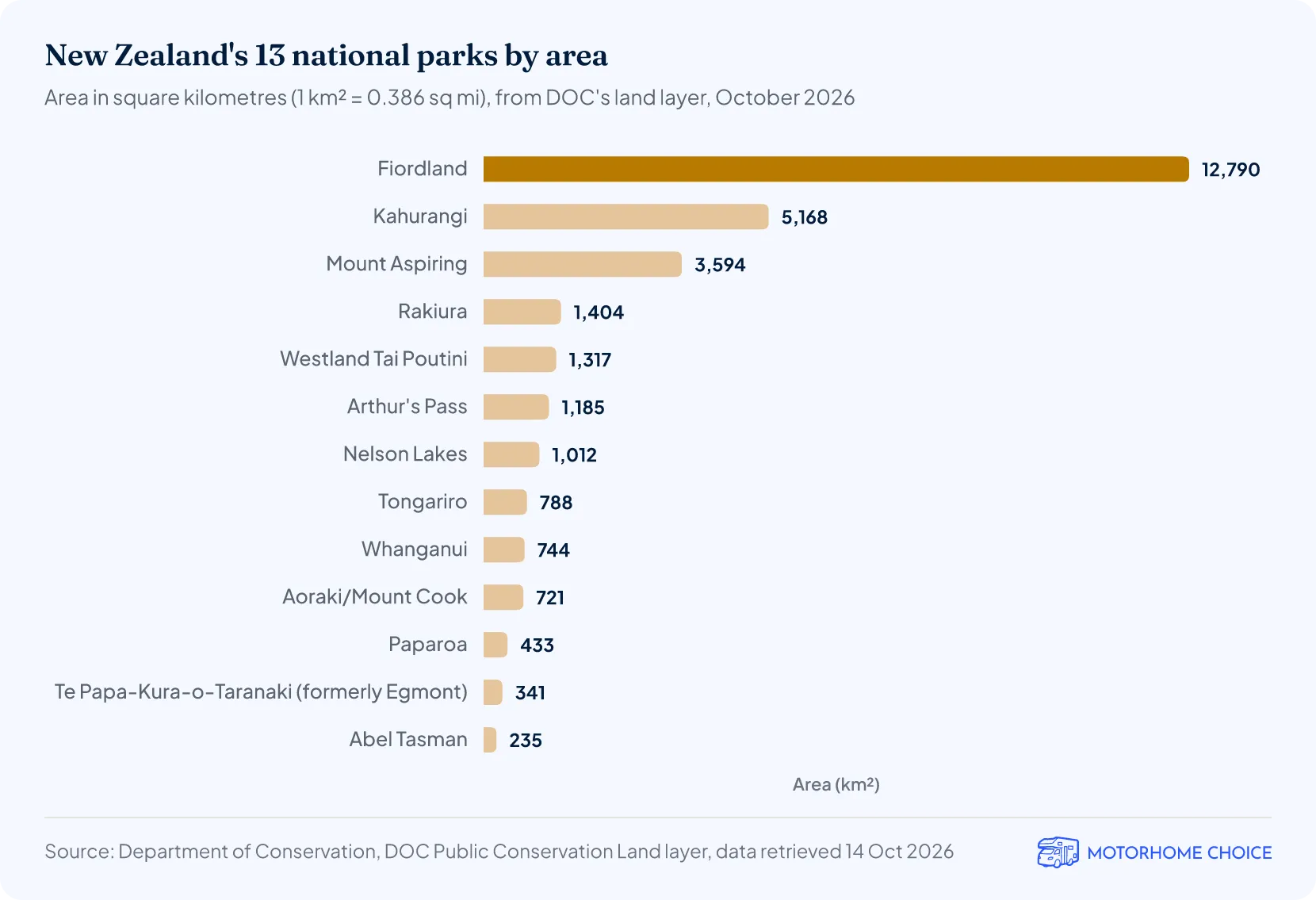
Fiordland is New Zealand's largest national park, at 1,278,970 hectares (12,790 km²; 4,938 sq mi)1. It was declared a World Heritage Area in 19868.
Fiordland alone is 43% of all national-park land in New Zealand, and bigger than the next four parks combined: Kahurangi, Mount Aspiring, Rakiura and Westland Tai Poutini, which add up to 1.15 million hectares1.
The smallest national park is Abel Tasman, at 23,506 hectares (235 km²; 91 sq mi)1. Fiordland is about 54 times its size.
How much of New Zealand is national park?
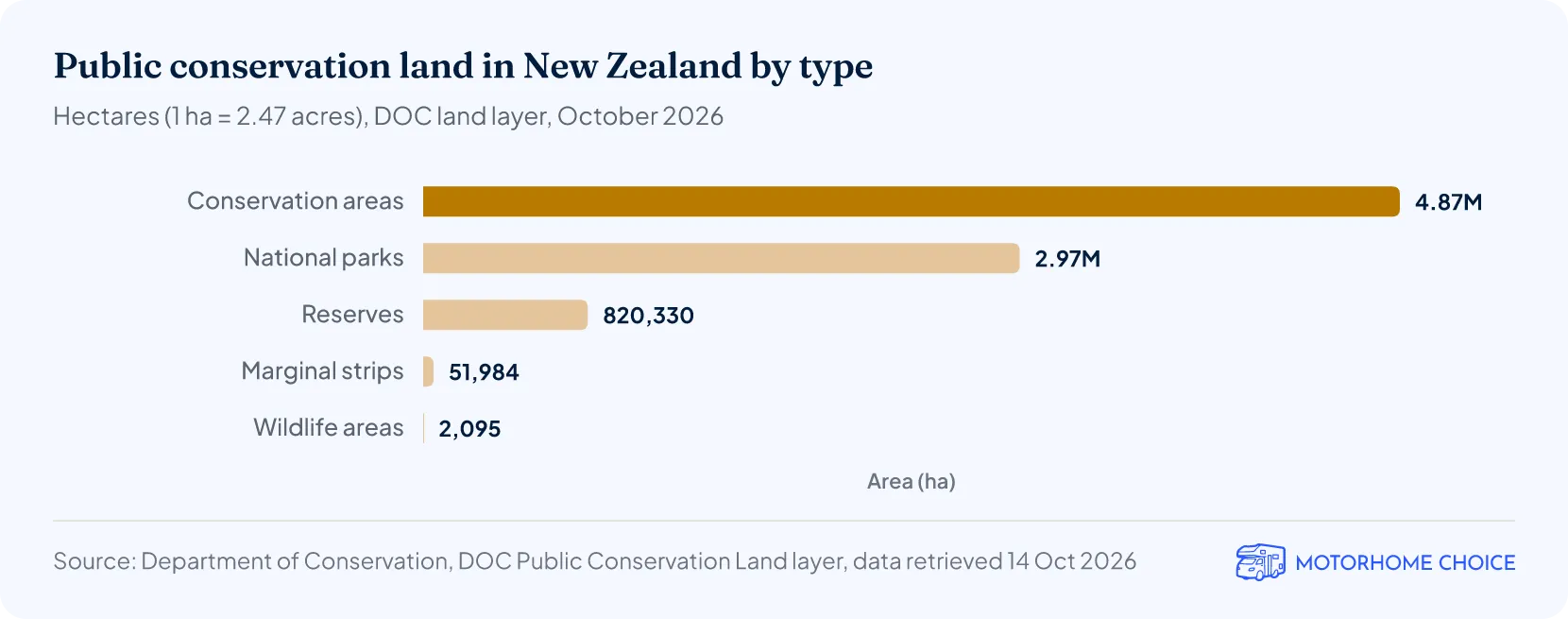
National parks cover 2.97 million hectares, 34% of the 8.72 million hectares of public conservation land (October 2026)1. Most of the rest is conservation areas, at 4.87 million hectares, with reserves making up another 0.82 million hectares.
DOC's annual report for 2024/25 says the department is responsible for 8.6 million hectares of land, nearly a third of New Zealand, as well as 4.5 million hectares of water3. Te Ara, the government's online encyclopedia of New Zealand, puts the national parks at around 11% of the country (2019)4.
What is the oldest national park in New Zealand?
Tongariro is New Zealand's oldest national park, established in 18942. DOC records that Ngāti Tūwharetoa made the heart of the mountain area sacrosanct in 1887, which led to the park's creation, "a first for New Zealand, and fourth in the world". In 1993 Tongariro became the first property inscribed on the World Heritage List under the revised criteria for cultural landscapes.
Te Papa-Kura-o-Taranaki (then Egmont) followed in 1900 and Arthur's Pass in 19294. Six parks were created between 1942 (Abel Tasman) and 1964 (Mount Aspiring). The newest is Rakiura, established in 2002.
In 2026 Tongariro turns 132 and Rakiura 24. The median park, Nelson Lakes, is 70 years old.
Which national parks get the most visitors?
Fiordland and Aoraki/Mount Cook are the national parks most visited by international travellers: 21% and 20% of international visitors went to them in the year to June 20255, according to DOC's analysis of the International Visitor Survey. Tongariro was next, at 12%.
Over the same year, 52% of international visitors went to at least one national park5, and New Zealand had 3.38 million international visitor arrivals.
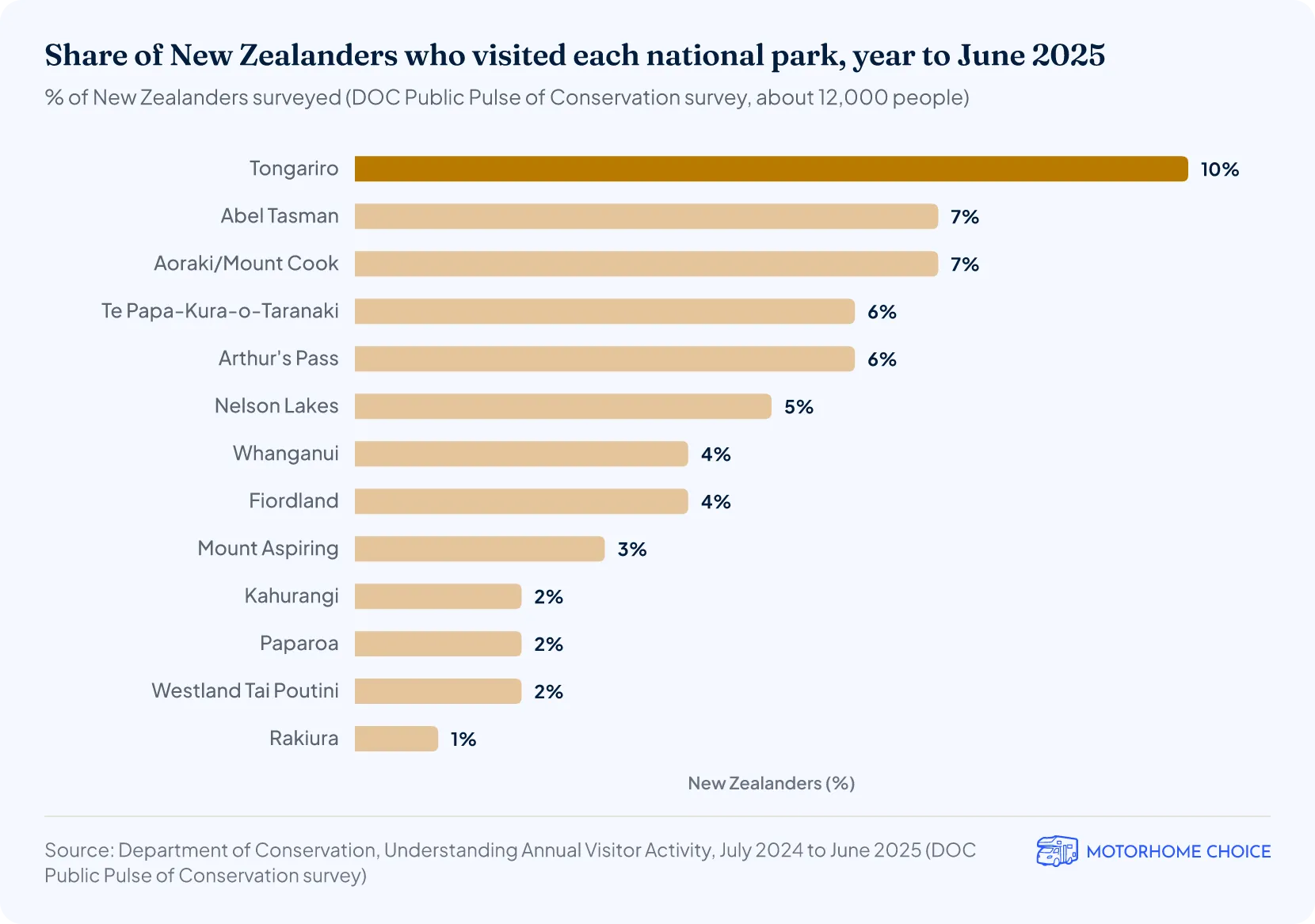
New Zealanders favour parks closer to home. In DOC's survey of New Zealanders for the year to June 2025, 44% had visited at least one national park5, and Tongariro (10%), Abel Tasman (7%) and Aoraki/Mount Cook (7%) were the most visited. Only 4% had been to Fiordland, in the far south-west of the South Island. To drive between the parks, compare campervan and motorhome hire in New Zealand.
Which national parks are busiest for their size?
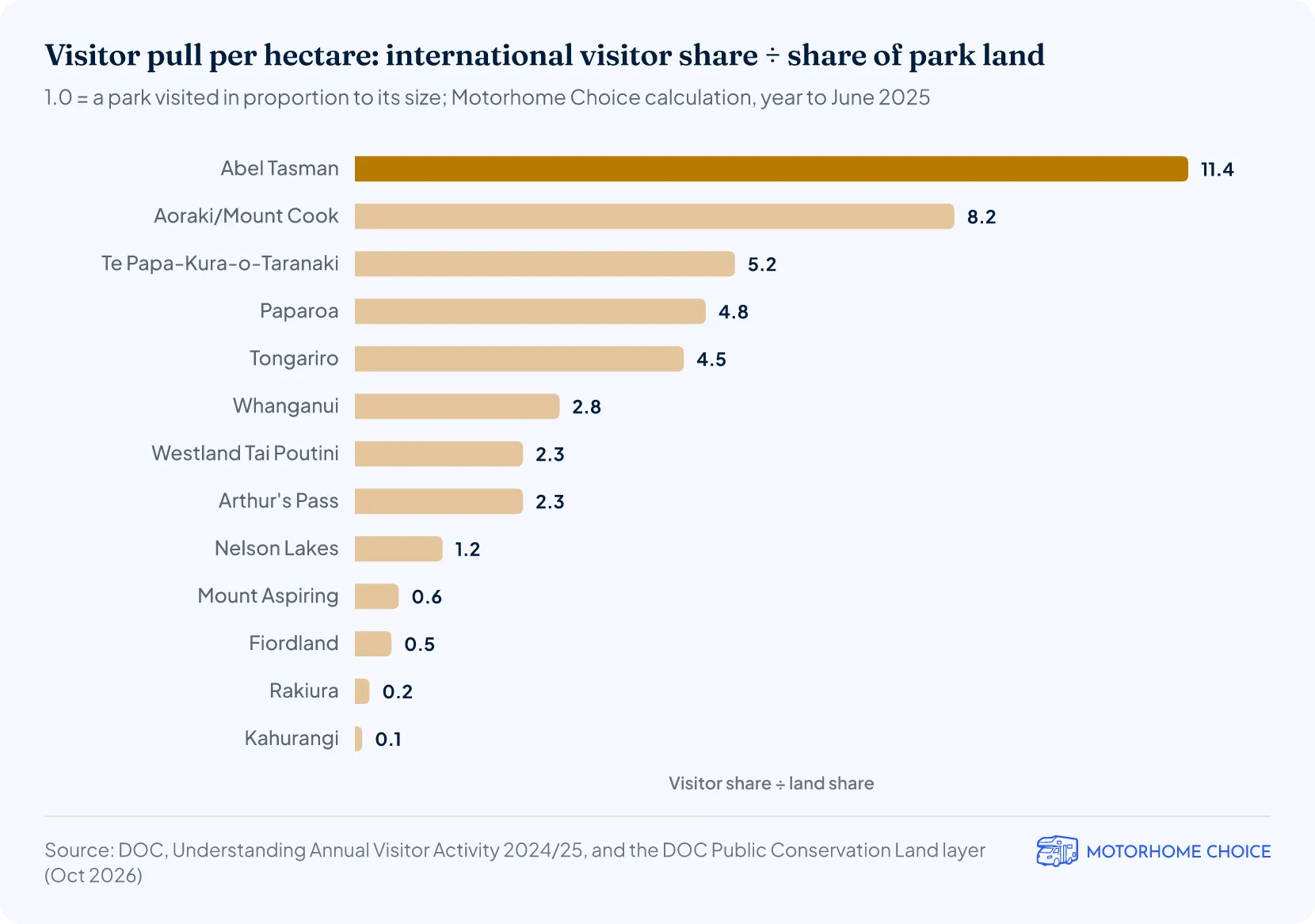
Abel Tasman is the busiest national park for its size. It covers 0.8% of New Zealand's national-park land1 but drew 9% of international visitors in the year to June 20255, 11.4 times its share of the land (our calculation). Aoraki/Mount Cook follows at 8.2 times and Te Papa-Kura-o-Taranaki at 5.2 times.
At the other end, Fiordland draws the most international visitors of any park, but with 43% of the land its ratio is 0.5. Kahurangi, the second-largest park, is at 0.1.
How busy are the Great Walks in national parks?
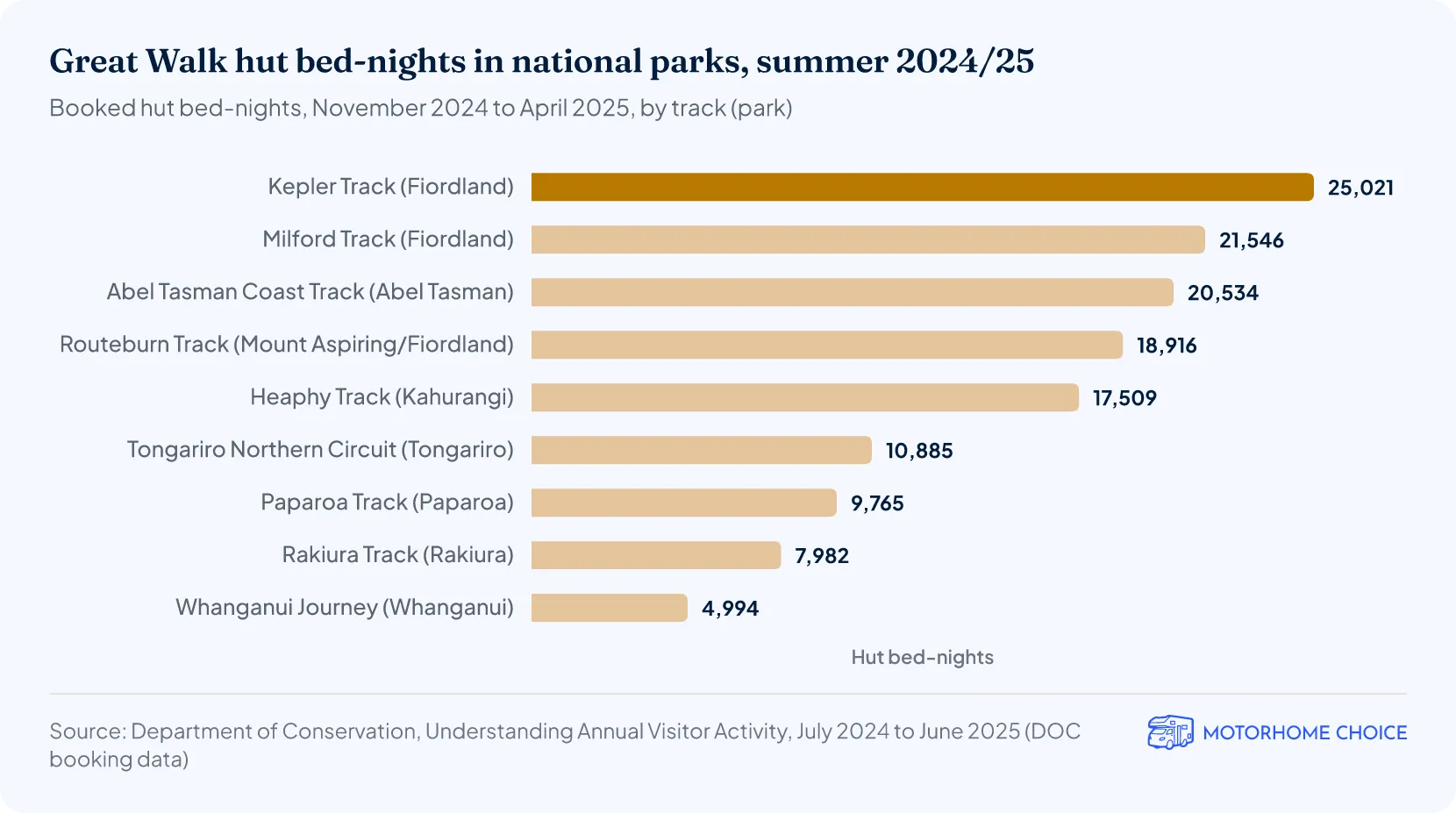
Hut bookings on the nine Great Walks inside national parks reached 137,152 bed-nights in the 2024/25 summer season (November to April). The Kepler Track in Fiordland was the busiest, with 25,021 bed-nights5, and the Milford Track and Abel Tasman Coast Track were both 95% full.
Across all 11 Great Walks, DOC recorded 154,215 hut bed-nights at 78% occupancy5. Bed-nights count nights booked in huts, not individual walkers.
More New Zealand facts & statistics
Campervan hire in New Zealand
References
- Department of Conservation Annual Report for the year ended 30 June 2025doc.govt.nzPublished 2025-11-05 · Retrieved 2026-10-14
- New Zealand's national parks at 11 May 2019 (Te Ara – The Encyclopedia of New Zealand)teara.govt.nzRetrieved 2026-10-14
- Te Ture Whakatupua mō Te Kāhui Tupua 2025/Taranaki Maunga Collective Redress Act 2025 (Public Act 2025 No 1)Parliamentary Counsel OfficePublished 2025-02-01 · Retrieved 2026-10-14