

Published
Cook Strait key facts
- Width: about 22.5 km (14 miles) across, the swim crossing distance12.
- Depth: Cook Strait Canyon is about 3,000 m (9,800 ft) deep south of Cape Palliser3.
- Ferry crossing: 96 km (52 nautical miles), about 3.5 hours between Wellington and Picton4.
- Passengers: more than 470,000 on the Interislander in the year to 30 June 20265.
- Sailings: around 2,600 a year with two ships (year to June 2026)5.
- Reliability: 99% of advertised sailings delivered, excluding weather (year to June 2026)5.
- Swimmers: more than 130 successful crossings by swimmers from 19 countries (to May 2021)1.
- New ferries: two 200-metre ships for about 1,500 passengers each, due in service in 20296.
How wide is Cook Strait?
Cook Strait is about 22.5 kilometres (14 miles) across, the distance New Zealand’s official histories give for the swim crossing between the North and South Islands12. Guinness World Records describes the channel as 23 kilometres (14.3 miles) wide in its swim records7.
The strait joins the Tasman Sea and the Pacific Ocean. Its Māori name appears as Te Moana o Raukawakawa on Interislander’s journey guide4, and as Te Moana-o-Raukawa in Guinness World Records’ listing7. The ferry route is more than four times longer than the strait is wide, because it starts in Wellington Harbour and winds through Kura Te Au (Tory Channel) and the Marlborough Sounds to Picton4.
How deep is Cook Strait?
The deepest part of Cook Strait is the Cook Strait Canyon, which starts about 10 kilometres (6 miles) off the coast in 50 metres (164 feet) of water and drops to about 3,000 metres (9,800 feet) south of Cape Palliser, according to NIWA (2017)3.
NIWA describes the canyon as one of the largest in the world. Its scientists have mapped more than 150 submarine landslides in the canyon system, ranging from 2.5 million cubic metres to about 10 cubic kilometres, and some of the largest are up to four times the size of Wellington’s Mount Victoria3.
How long is the ferry from Wellington to Picton?
The Interislander crossing between Wellington and Picton is 96 kilometres (52 nautical miles) and takes about three and a half hours4. About two-thirds of the trip is spent in Wellington Harbour and the channels of the Marlborough Sounds, and the remaining third in the open strait. The halfway point comes about 1 hour 40 minutes into the sailing in either direction. The average speed over the whole route is about 27 kilometres per hour (17 mph), or about 15 knots.
Two companies run the crossing: KiwiRail’s Interislander and Bluebridge, which also carries cars, campervans and motorhomes8.
To skip the crossing on a South Island campervan or motorhome trip, fly into Christchurch and start with campervan hire in Christchurch. If you hire in the North Island instead, check that your rental company’s terms allow its vehicle on the ferry before you book a sailing.
How many passengers does the Interislander carry?
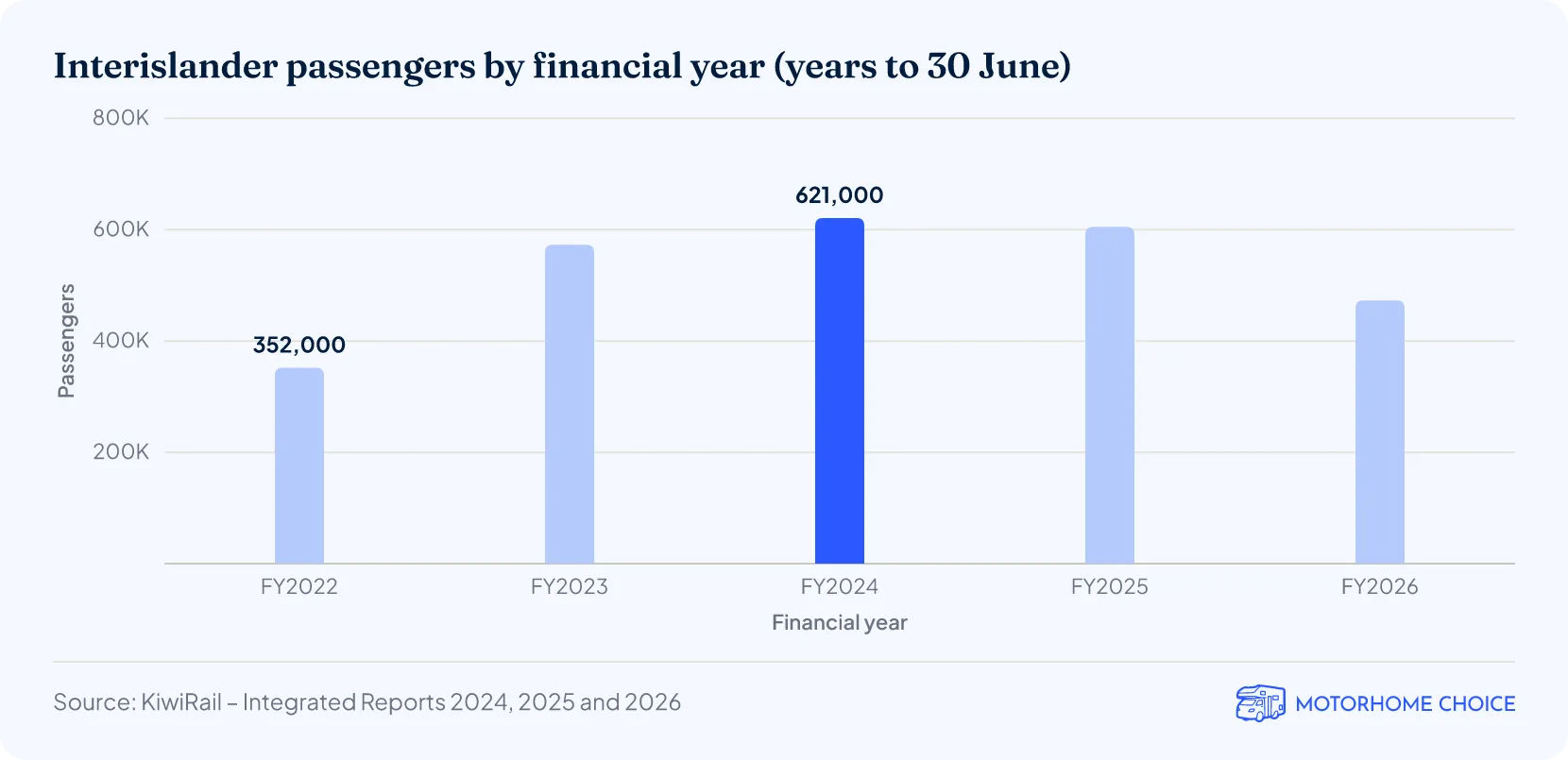
The Interislander carried more than 473,000 passengers, 175,000 passenger vehicles and 68,000 commercial vehicles in the year to 30 June 2026, its first full year with two ships5. That is about 22% fewer passengers than the 605,000 in the year to June 2025 and about 24% fewer than the 621,000 peak in the year to June 2024 (our calculation)910.
| Interislander traffic: three ships vs two ships | ||
|---|---|---|
| Measure | Three ships (a year, c. 2024–25) | Two ships (year to June 2026) |
| Passengers | 620,000+11 | 473,000+5 |
| Cars / passenger vehicles | 230,00011 | 175,000+5 |
| Commercial vehicles | 73,00011 | 68,000+5 |
| Sailings a year | 3,4009 | about 2,6005 |
Source · KiwiRail welcomes ferry announcement (March 2025); KiwiRail Integrated Reports 2025 and 2026
How many Interislander sailings are cancelled?
KiwiRail delivered 99% of advertised Interislander sailings in the year to 30 June 2026 (excluding weather cancellations), up from 98% the year before5.
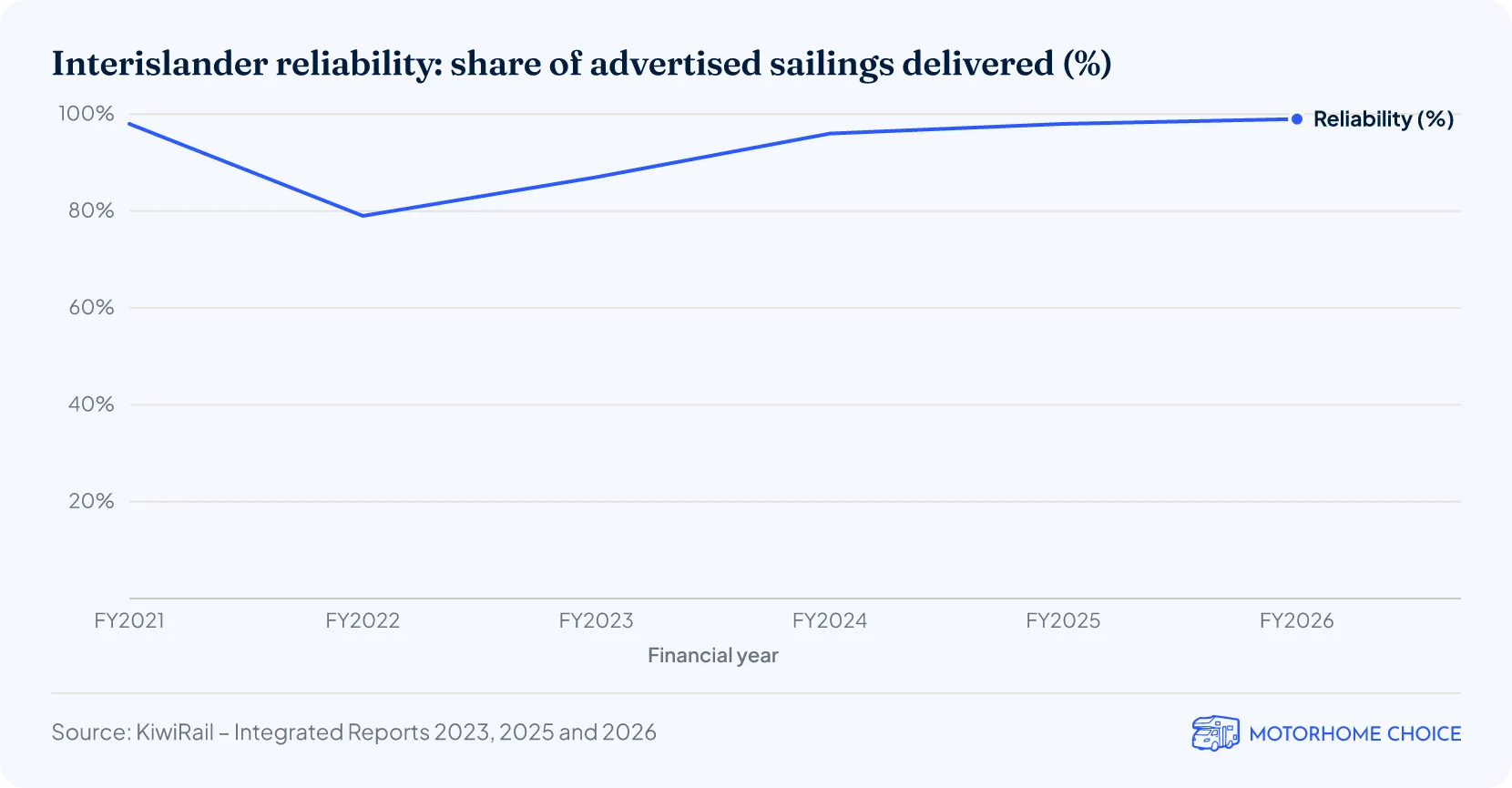
Reliability has recovered from a low of 79% in the year to June 202212. KiwiRail’s 2023 report says it brought in a stronger maintenance programme after unexpected disruptions on the Kaitaki, and reliability has risen every year since. In the year to June 2025, non-weather cancellations fell by 40% on the year before9.
Across all its train and ferry services, KiwiRail cancelled 564 services because of weather in the year to June 2025, about 7% of all its cancellations9.
Sailings and passengers per sailing
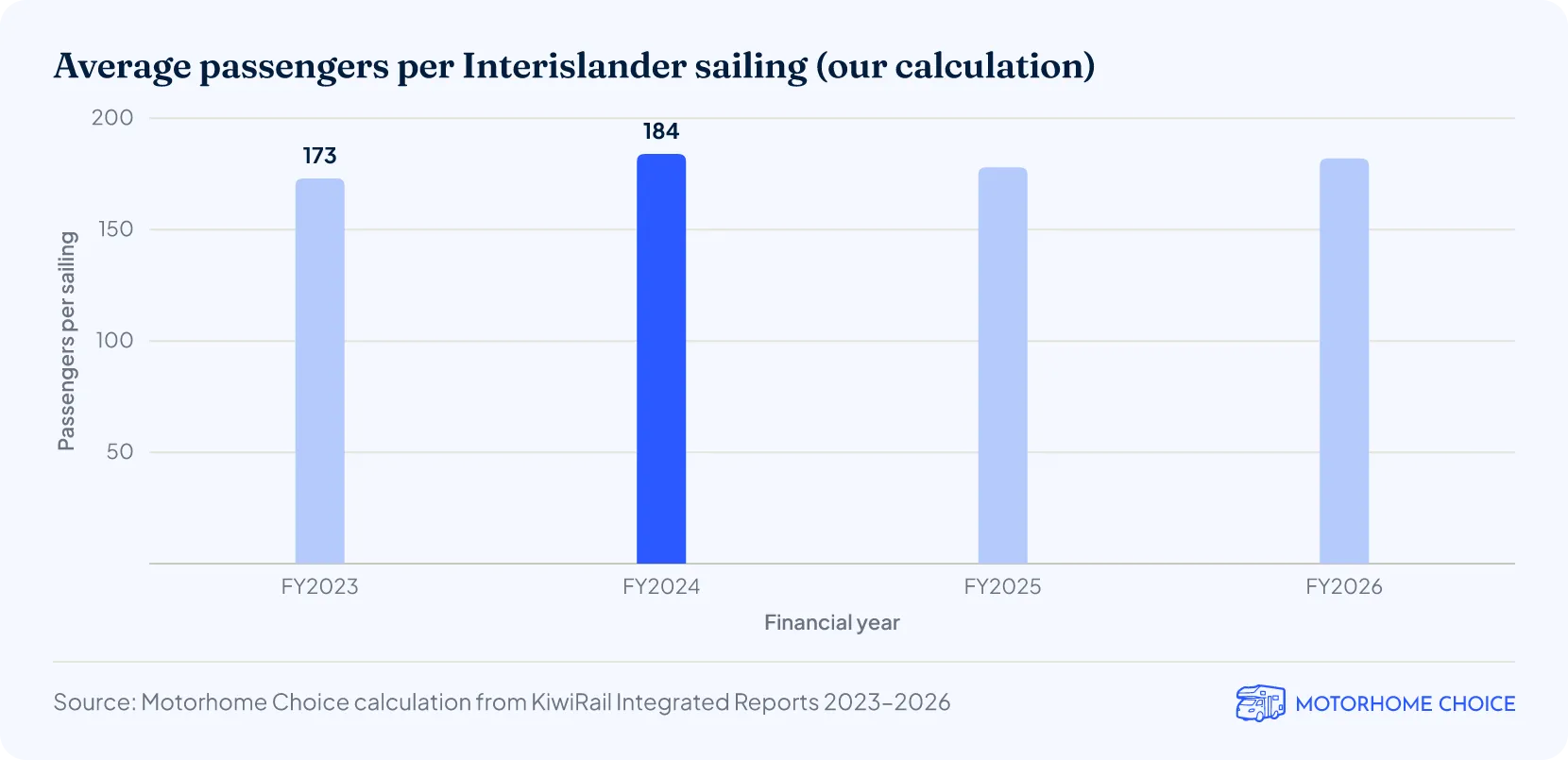
The Interislander ran about 2,600 sailings a year with two ships in 2025–26, down from 3,374 in the year to June 2024 with three510. By our calculation, each sailing still carried about 182 passengers on average in 2025–26, close to the 184 of 2023–24, because fewer ships ran fuller: KiwiRail says utilisation rose from 73% to 83%5.
How much does the Interislander earn?
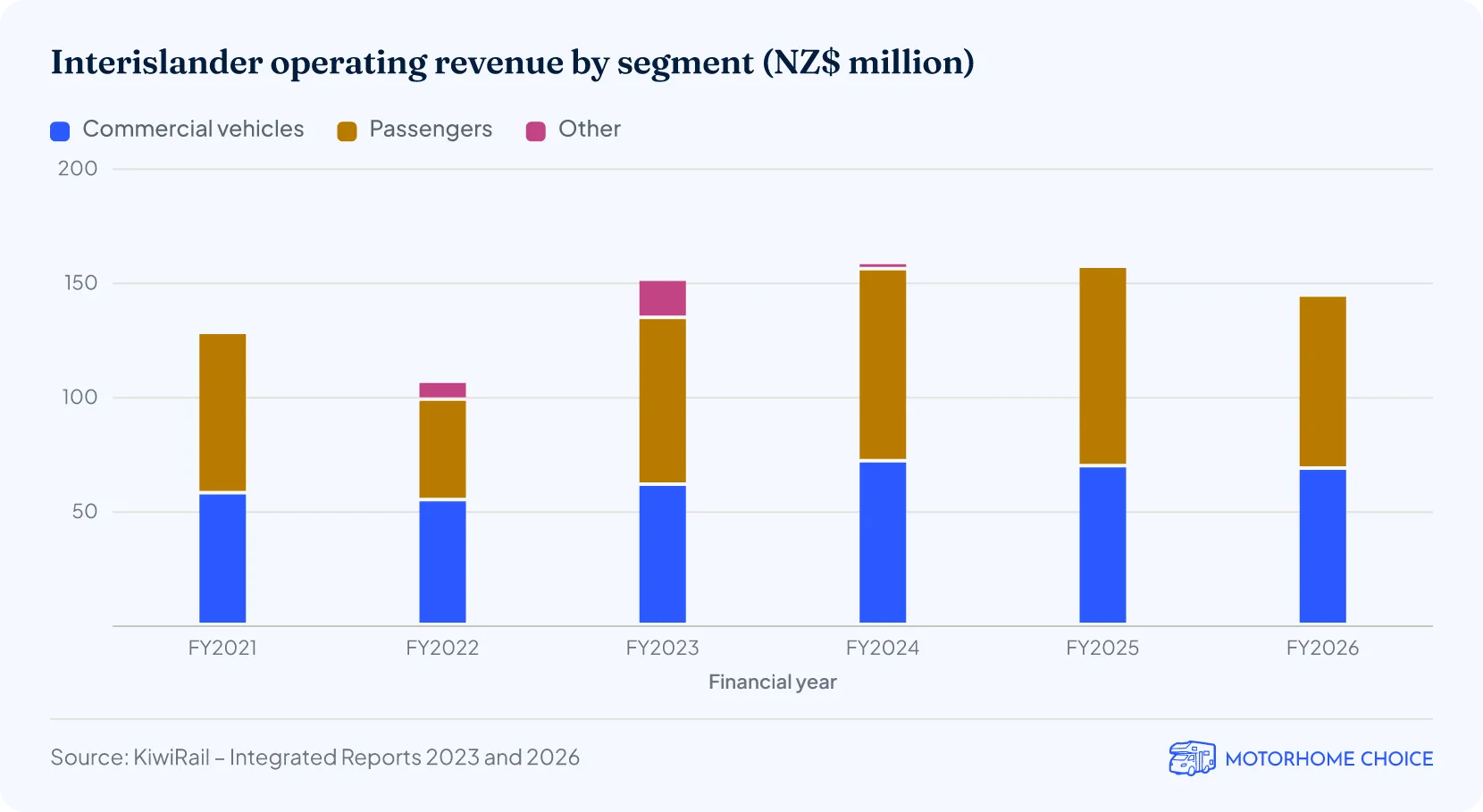
Interislander operating revenue was NZ$144.8 million in the year to 30 June 2026, down NZ$12.3 million (7.8%) on the year before after the move to two ships5. Passenger revenue was NZ$75.7 million and commercial vehicle revenue NZ$68.4 million.
How big are the new Cook Strait ferries?
Two identical rail-enabled ferries, each 200 metres (656 feet) long and 28 metres (92 feet) wide with room for 1,530 passengers, are due to enter service on Cook Strait in 2029, according to Crown company Ferry Holdings (July 2026)6. They are being built in China by Guangzhou Shipyard International, construction of the first ship is scheduled to begin in May 2027, and the programme runs within a government-approved NZ$1.704 billion funding envelope, excluding NZ$220 million of delivery-partner contributions.
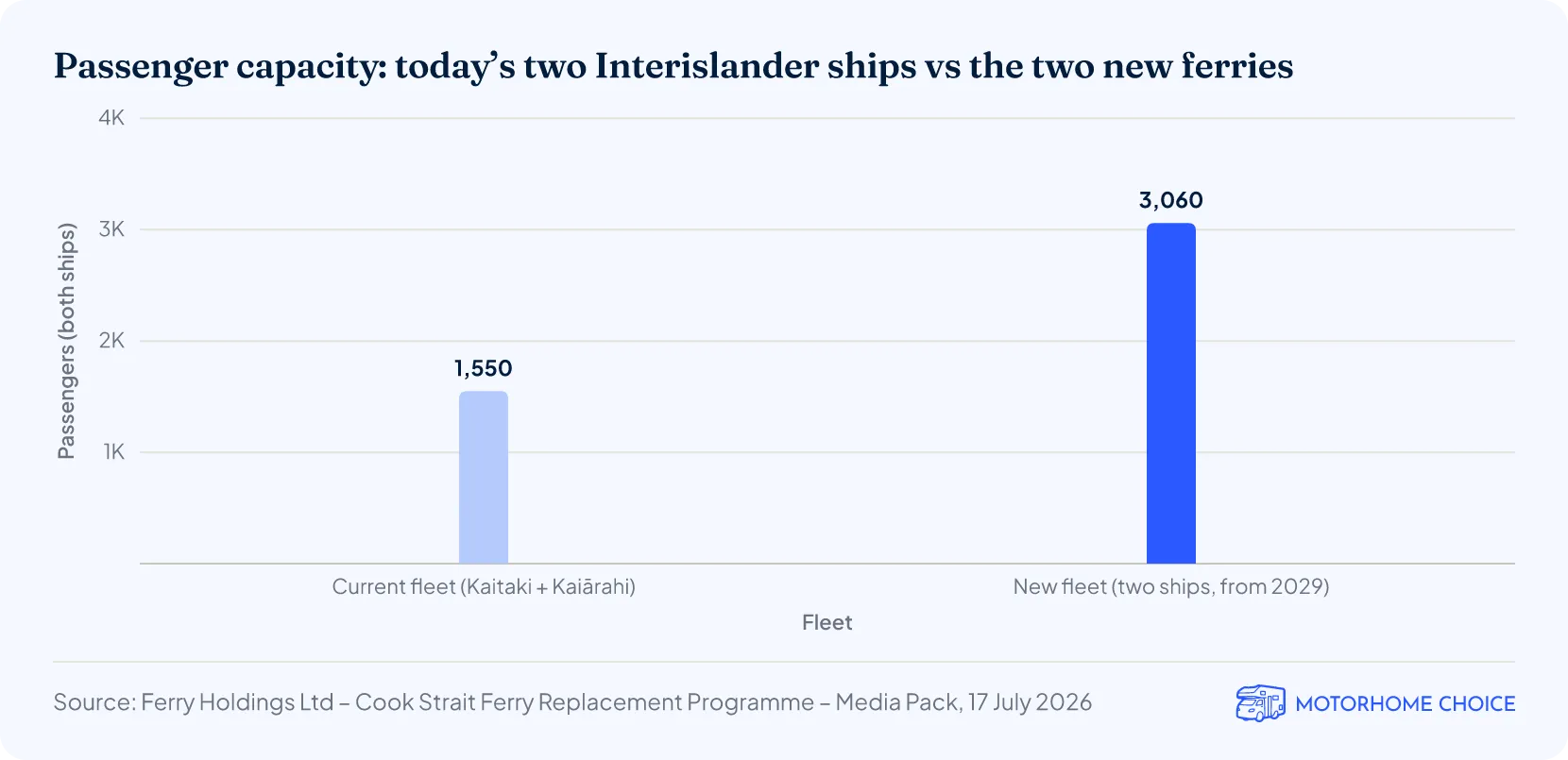
By our calculation, the two new ships will carry 3,060 passengers between them, 97% more than the 1,550 of today’s Kaitaki and Kaiārahi. Ferry Holdings describes the gain as 63% more passenger space6.
| Today’s Interislander ships vs the new ferries | ||
|---|---|---|
| Measure | Current ferries | New ferries (each) |
| Length | Kaitaki 182 m; Kaiārahi 180 m6 | 200 m (656 ft)6 |
| Width | Kaitaki 23 m; Kaiārahi 25 m6 | 28 m (92 ft)6 |
| Passengers | Kaitaki 1,000; Kaiārahi 5506 | 1,5306 |
| Vehicle lane metres | Kaitaki 1,780; Kaiārahi 1,8006 | 2,800 (no wagons); 1,606 with 40 wagons6 |
| Rail wagons | None6 | Up to 406 |
Source · Ferry Holdings Ltd, Cook Strait Ferry Replacement Programme Media Pack, 17 July 2026
| Cook Strait ferry timeline, 2023–2029 | |
|---|---|
| Date | Event |
| 2023–24 | The iReX programme for new ferries is cancelled during KiwiRail’s financial year to June 2024.10 |
| June 2024 | Aratere runs aground near Picton.10 |
| March 2025 | The Government announces two new rail-enabled ferries, to enter service in 2029.119 |
| August 2025 | Aratere retires; Interislander moves to two ships.5 |
| November 2025 | Shipbuilding contract signed in Guangzhou, China.6 |
| May 2027 | Construction of the first new ship scheduled to begin.6 |
| 2029 | New ferries due to enter service.6 |
Source · KiwiRail Integrated Reports 2024–2026; Ferry Holdings Ltd Media Pack, 17 July 2026
How many people have swum Cook Strait?
By May 2021, 119 people from 19 countries had made 131 successful swims across Cook Strait, according to the Ministry for Culture and Heritage1. The first person to succeed was Barrie Devenport on 20 November 1962.
The fastest crossing is 4 hours 33 minutes 50 seconds, by Andrew Donaldson from south to north on 7–8 March 2023, ratified by the New Zealand Open Water Swimming Association7.
| Cook Strait swimming milestones | |||
|---|---|---|---|
| Milestone | Swimmer | Date | Detail |
| First attempts | R.G. Webster and Lily Copplestone | 1929 | Unsuccessful1 |
| First crossing | Barrie Devenport (New Zealand) | 20 Nov 1962 | North to south, 11 h 20 min13 |
| First woman | Lynne Cox (United States) | 4 Feb 1975 | North to south, 12 h 7 min12 |
| First non-stop double crossing | Philip Rush | 13 Mar 1984 | Rush swam the strait six times in all1 |
| Fastest woman | Denise Anderson (New Zealand) | 20 Jan 1986 | South to north, 5 h 4 min13 |
| Youngest | Aditya Raut | 20 Feb 2005 | Aged 111 |
| Oldest (to 2021) | Toshio Ogawa | 3 Mar 2015 | Aged 601 |
| Fastest overall | Andrew Donaldson | 7–8 Mar 2023 | South to north, 4 h 33 min 50 s7 |
Source · NZHistory; Te Ara; Guinness World Records
Successful swimmers are given lifetime free Interislander crossings through its Freedom of the Ferries scheme4.
What runs under Cook Strait?
The HVDC Inter-Island link carries electricity under Cook Strait between the South and North Islands. It was commissioned in 1965 with 570 kilometres (354 miles) of overhead line and three submarine cables across 40 kilometres (25 miles) of the strait, according to Transpower (2024)14.
A 1991 upgrade added three new submarine cables; the original cables were all retired by 1996, and a second upgrade in 2013 gave today’s northward capacity of 1,200 megawatts14. In March 2024 Transpower said it was preparing to replace the cables by 2032.
How dangerous is Cook Strait?
New Zealand’s worst modern maritime disaster happened within sight of Wellington: the Lyttelton–Wellington ferry Wahine sank in a storm on 10 April 1968, and 53 people eventually died, 51 of them on the day15. Interislander describes the strait as one of the most violent and unpredictable stretches of water in the world, but calm most of the time4.
More New Zealand facts & statistics
Campervan hire in New Zealand
References
- Scientists set to delve into the secrets of the Cook Strait mega-canyonniwa.co.nzPublished 2017-06-06 · Retrieved 2026-10-14
- Cook Strait Ferry Replacement Programme – Media Pack, 17 July 2026ferryholdings.co.nzPublished 2026-07-17 · Retrieved 2026-10-14
- Examining the purpose and future role of our HVDC link (discussion paper)static.transpower.co.nzPublished 2024-03-01 · Retrieved 2026-10-14