

Published
Key facts
- 23.3 million sheep were farmed in New Zealand at 30 June 2025, down 1.4% on 20241.
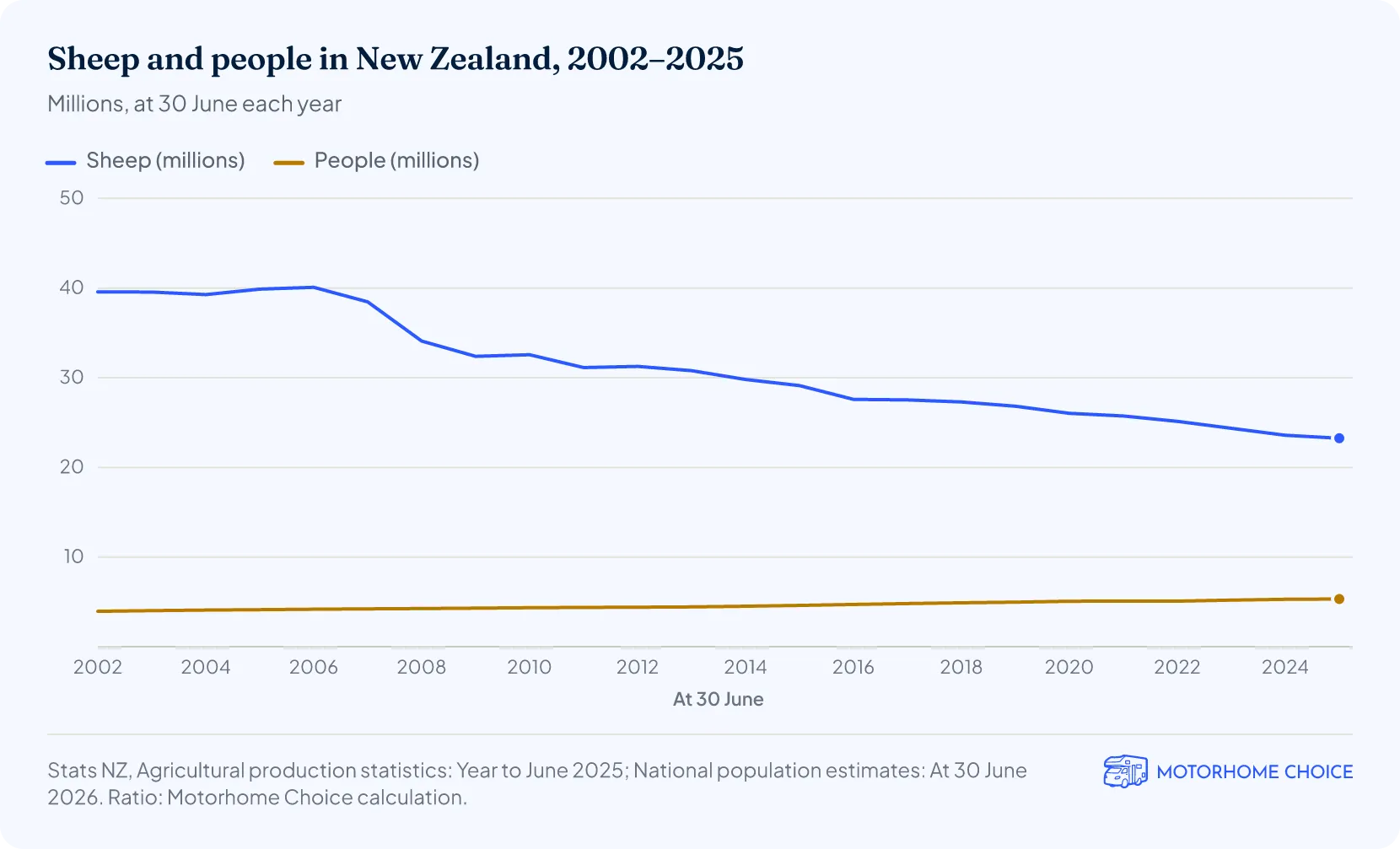
- About 4.4 sheep per person in 2025: 23.3 million sheep1 and 5.3 million people at 30 June 20252.
- More than 70 million sheep, or 22 for every person, was the all-time peak, in 19823.
- Down about 41%: the flock fell from 39.6 million in 2002 to 23.3 million in 20251.
- 5.8 million dairy cattle and 3.8 million beef cattle were farmed at 30 June 20251.
- 4.7 million dairy cows were milked in the 2024/25 season, in about 10,400 herds4.
- 22.8 million sheep at 30 June 2026 is Beef + Lamb New Zealand's survey estimate, down 2% on 20255.
- About 710,000 farmed deer were counted at 30 June 2025, up 0.4% on 20241.
How many sheep are in New Zealand?
New Zealand had 23,252,000 sheep at 30 June 2025, Stats NZ's final figure for that year, down 1.4% on the 23,583,000 counted a year earlier1. Stats NZ publishes the count once a year, in April, from its survey of farms.
- Beef + Lamb New Zealand, the sheep and beef farmers' industry body, estimates the flock fell a further 2.0% to 22.78 million by 30 June 20265. This is a survey estimate from about 500 farms, not an official count; Stats NZ's June 2026 figure is due in April 20271.
- Breeding ewes made up 14.42 million of the 2025 flock and hoggets (young sheep) 8.02 million5, Beef + Lamb New Zealand's tables show.
- The 2025 total is the lowest in Stats NZ's 2002–2025 series, and the flock has shrunk every year since 20121.
- Beef + Lamb New Zealand forecasts a lamb crop of 19.75 million in spring 2026, down 0.3%5.
How many sheep per person are there in New Zealand?
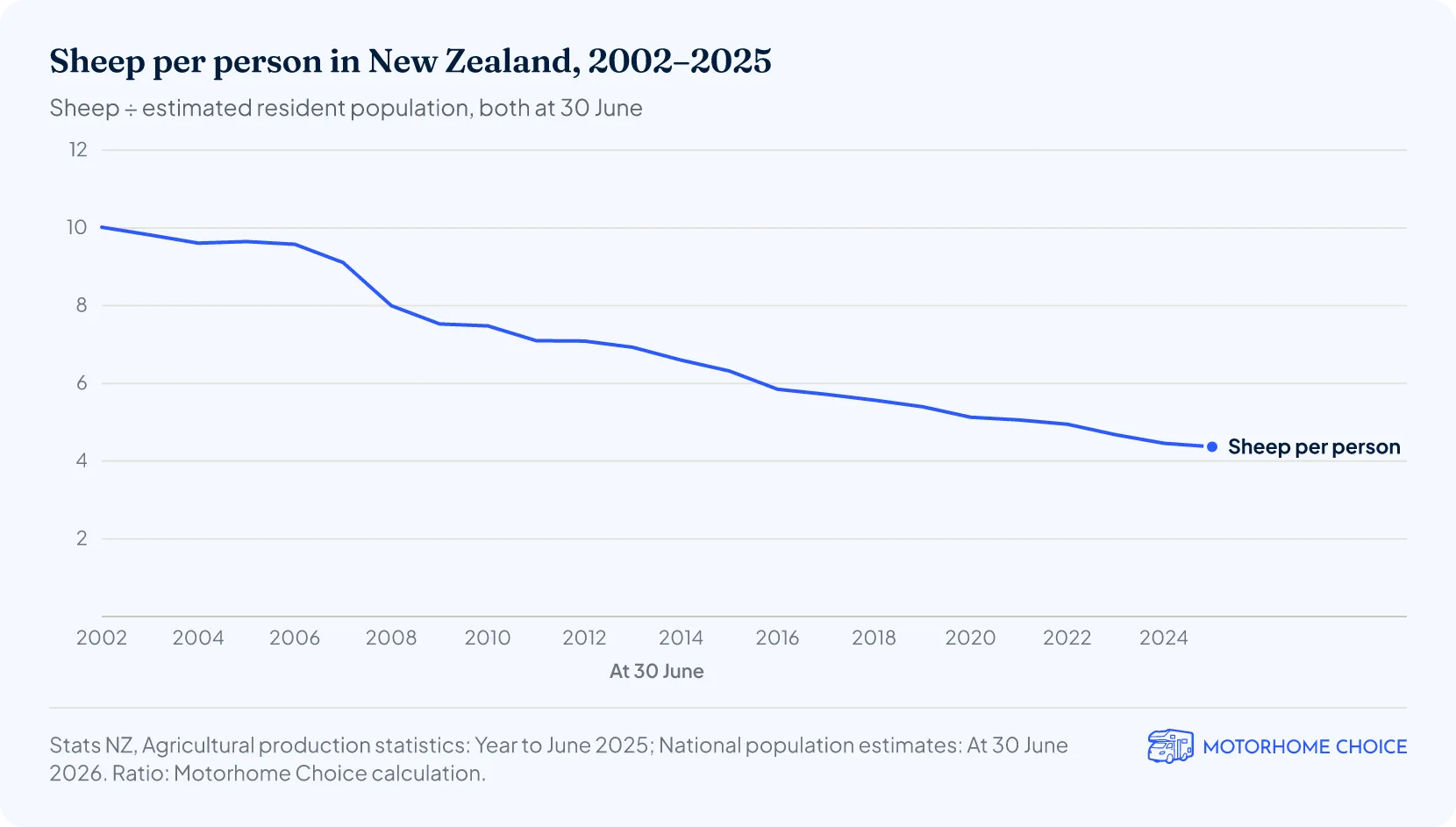
There were about 4.4 sheep for every person in New Zealand at 30 June 2025: 23,252,000 sheep1 and an estimated 5,321,000 people2. In 2002 there were 10 sheep per person3.
- The ratio has more than halved since 2002 because the flock shrank by 41% while the population grew by 35%, from 3.95 million to 5.32 million2.
- On Beef + Lamb New Zealand's June 2026 estimate of 22.78 million sheep5 and Stats NZ's provisional population of 5,357,3002, the ratio falls to about 4.3 in 2026.
When did New Zealand have the most sheep?
New Zealand's sheep numbers peaked in 1982, when there were more than 70 million sheep, or 22 for every person, Stats NZ says3. The 2025 flock of 23.3 million is about a third of that peak.
- By 1990 the flock had fallen to 57.9 million, and between 1990 and 2019 it fell a further 53.6% to 26.8 million, Stats NZ's livestock indicator shows6. Over the same years dairy cattle rose 82%, from 3.4 million to 6.3 million.
- In Stats NZ's current series, which starts in 2002, the high point was 40.08 million sheep in 20061.
- Beef + Lamb New Zealand puts the fall since 2000–01 at 46%, from 42.26 million to an estimated 22.78 million in June 20265.
How many cows are there in New Zealand?
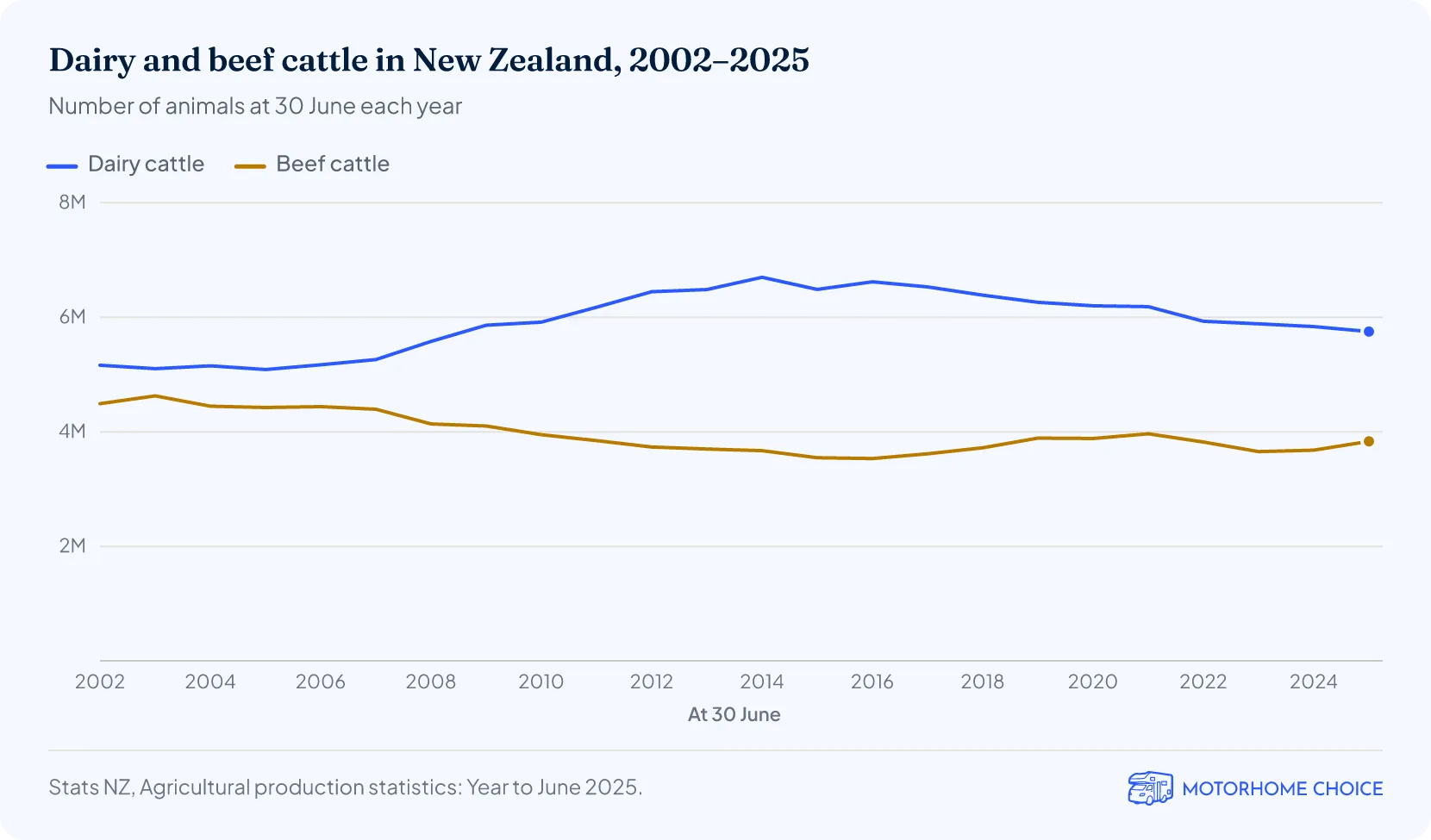
New Zealand had about 9.6 million cattle at 30 June 2025: 5.75 million dairy cattle and 3.83 million beef cattle, according to Stats NZ1. That is about 1.8 cattle for every person.
- Dairy cattle numbers fell 1.5% in the year to June 2025, while beef cattle rose 4.2%1.
- Dairy cattle peaked at 6.70 million in 2014 in Stats NZ's 2002–2025 series and have fallen by about 14% since1.
- Beef + Lamb New Zealand estimates beef cattle rose a further 3.3% to 3.96 million by 30 June 2026, the third yearly rise in a row, with increases in every region5.
- There are more dairy cattle than people in New Zealand: 5.75 million against 5.32 million, or about 1.1 per person2.
How many dairy cows are in New Zealand?
New Zealand milked 4.68 million dairy cows in the 2024/25 season, 0.5% fewer than the season before, according to DairyNZ and LIC4. Stats NZ's larger figure of 5.75 million is all dairy cattle on farms at 30 June 2025, not only cows in milk1.
- The cows were milked in 10,370 herds, with an average herd of 451 cows4.
- Waikato has the most dairy cows, with 1,084,686 (23.2% of the national herd), followed by North Canterbury with 698,455 and Southland with 601,4344.
- Cows milked peaked at 5.02 million in the 2014/15 season4.
- There are about 0.9 milking cows for every person in New Zealand.
How do sheep, cattle and deer compare with people?
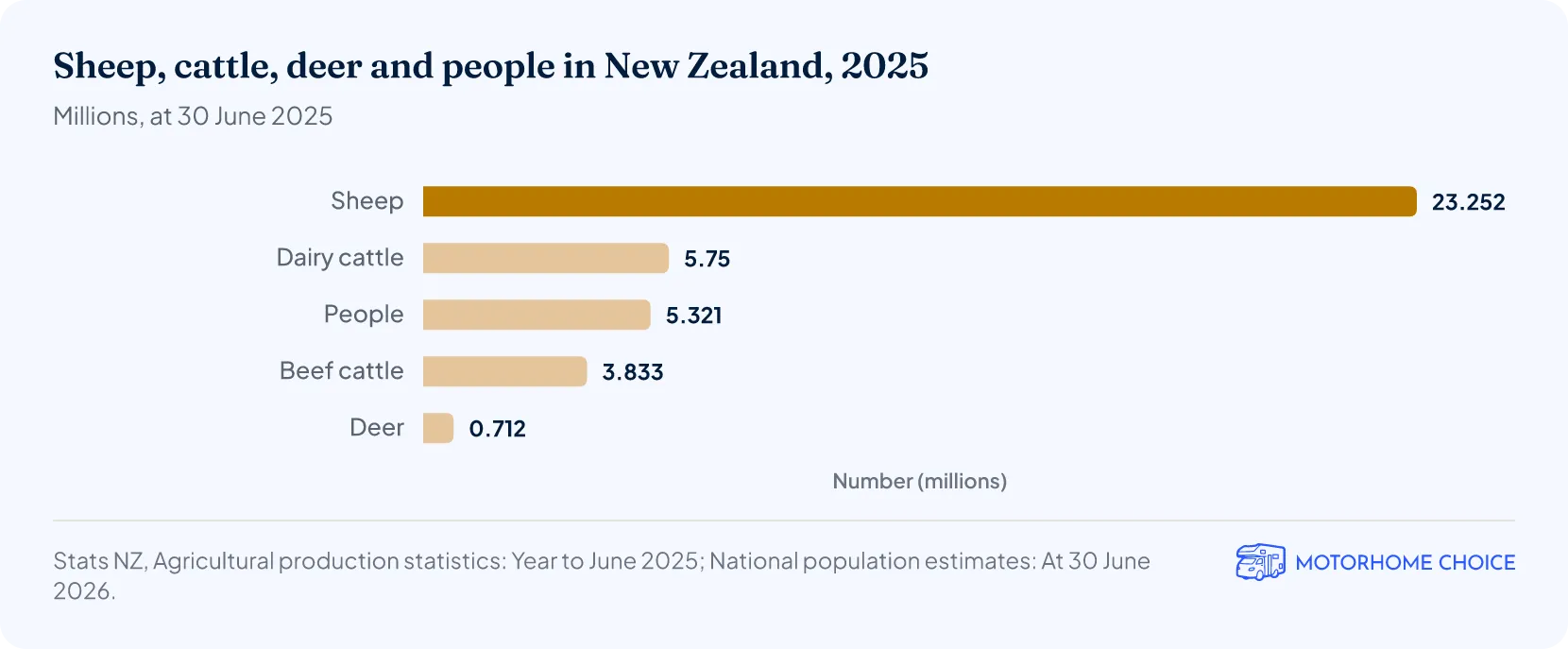
| Livestock and people in New Zealand, 30 June 2025 | |||
|---|---|---|---|
| Animals or people | Number at 30 June 2025 | Change on 2024 | Per person |
| Sheep | 23,252,000 | Down 1.4% | 4.37 |
| Dairy cattle | 5,750,000 | Down 1.5% | 1.08 |
| Beef cattle | 3,833,000 | Up 4.2% | 0.72 |
| All cattle (our total) | 9,583,000 | Up 0.7% | 1.80 |
| Farmed deer | 712,000 | Up 0.4% | 0.13 |
| People (estimated resident population) | 5,321,000 | Up 0.6% | 1.00 |
Source · Stats NZ, Agricultural production statistics: Year to June 2025 (April 2026); National population estimates: At 30 June 2026. Changes, the all-cattle total and per-person figures are our calculations.
Which region has the most sheep?
The East Coast region had the most sheep at 30 June 2025, with 5.80 million, followed by Marlborough-Canterbury with 5.24 million, according to Beef + Lamb New Zealand5.
- The South Island had slightly more sheep than the North Island in 2025: 11.77 million against 11.49 million5.
- Beef + Lamb New Zealand estimates sheep numbers fell in every region in the year to June 2026, most in Northland-Waikato-Bay of Plenty, down 6.3%, and least in Marlborough-Canterbury, down 0.5%5.
- The East Coast, Marlborough-Canterbury, Otago and Southland held about three in four of New Zealand's sheep in 20255. On a road trip with campervan hire in New Zealand, these are the regions where you will drive past the most sheep.
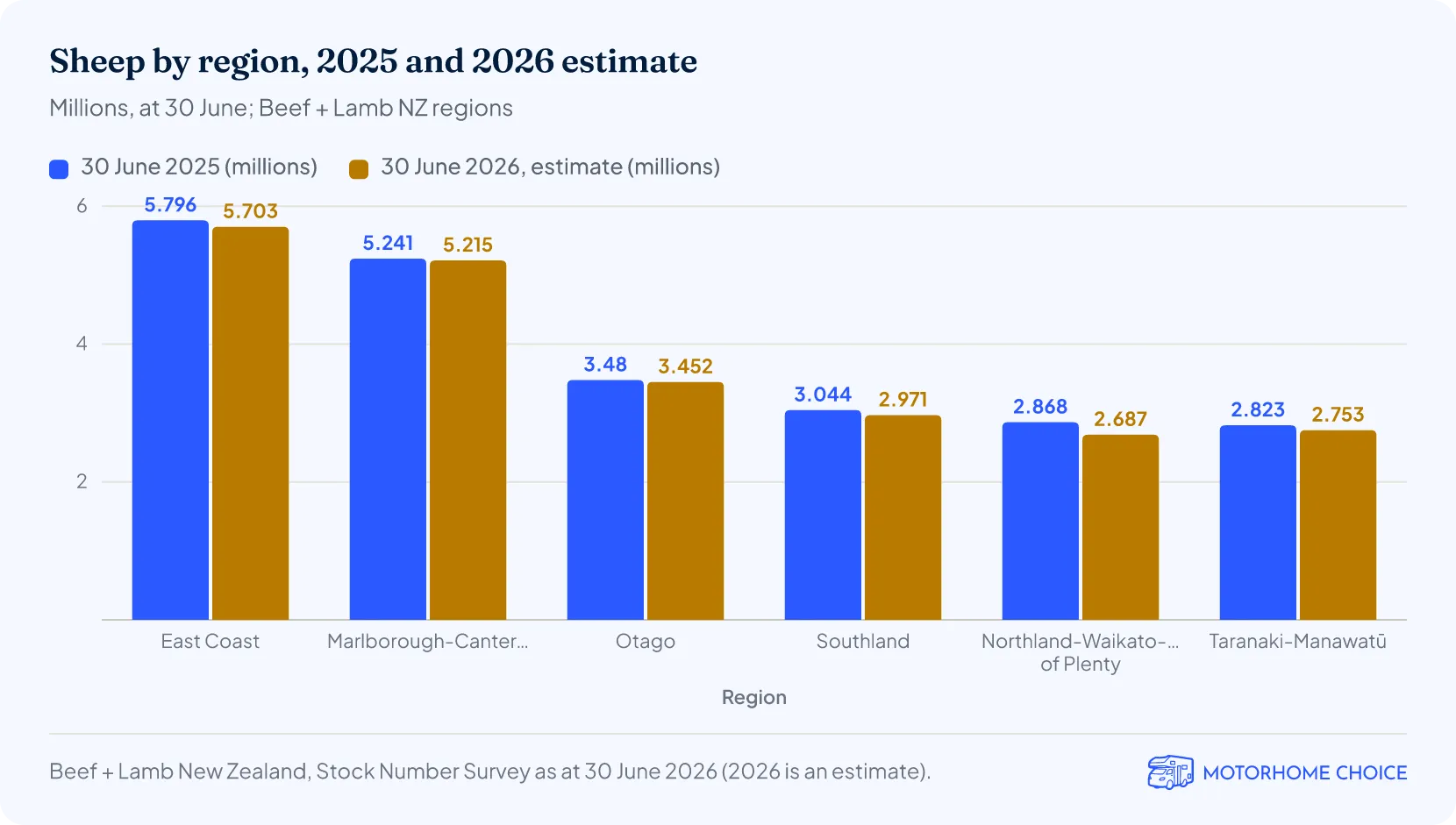
| Sheep by region, 2025 and 2026 estimate | |||
|---|---|---|---|
| Region | 30 June 2025 | 30 June 2026 (estimate) | Change |
| East Coast | 5,796,000 | 5,703,000 | −1.6% |
| Marlborough-Canterbury | 5,241,000 | 5,215,000 | −0.5% |
| Otago | 3,480,000 | 3,452,000 | −0.8% |
| Southland | 3,044,000 | 2,971,000 | −2.4% |
| Northland-Waikato-Bay of Plenty | 2,868,000 | 2,687,000 | −6.3% |
| Taranaki-Manawatū | 2,823,000 | 2,753,000 | −2.5% |
| North Island | 11,488,000 | 11,143,000 | −3.0% |
| South Island | 11,765,000 | 11,638,000 | −1.1% |
| New Zealand | 23,252,000 | 22,781,000 | −2.0% |
Source · Beef + Lamb New Zealand, Stock Number Survey as at 30 June 2026 (August 2026), Table 4. The 2025 figures are Stats NZ final numbers; 2026 figures are survey estimates.
Why are sheep numbers falling?
Sheep numbers are falling because sheep farmland has been turned to other uses, Beef + Lamb New Zealand says, including dairy conversion, forestry and native planting, retiring grazed land and urban development5. Farmers' decisions about staffing, succession and the returns from each kind of livestock have also moved farms from sheep towards cattle.
- On average, about 17% of the area of sheep and beef farms is set aside from grazing and cropping, Beef + Lamb New Zealand says5.
- In 2025–26, sustained cattle returns and the lower labour needs of cattle led farmers to keep more cattle relative to sheep, and fewer lambs were born in spring 20255.
- Sales of whole farms for forestry conversion eased in 2025–26 as policy settings changed, but land bought earlier for forestry kept being planted5.
More New Zealand facts & statistics
Campervan hire in New Zealand
References
- Agricultural production statistics: Year to June 2025stats.govt.nzPublished 2026-04-16 · Retrieved 2026-10-14
- National population estimates: At 30 June 2026stats.govt.nzPublished 2026-08-18 · Retrieved 2026-10-14
- Livestock numbers (environmental indicator, published April 2021)stats.govt.nzPublished 2021-04-15 · Retrieved 2026-10-14